
Overview
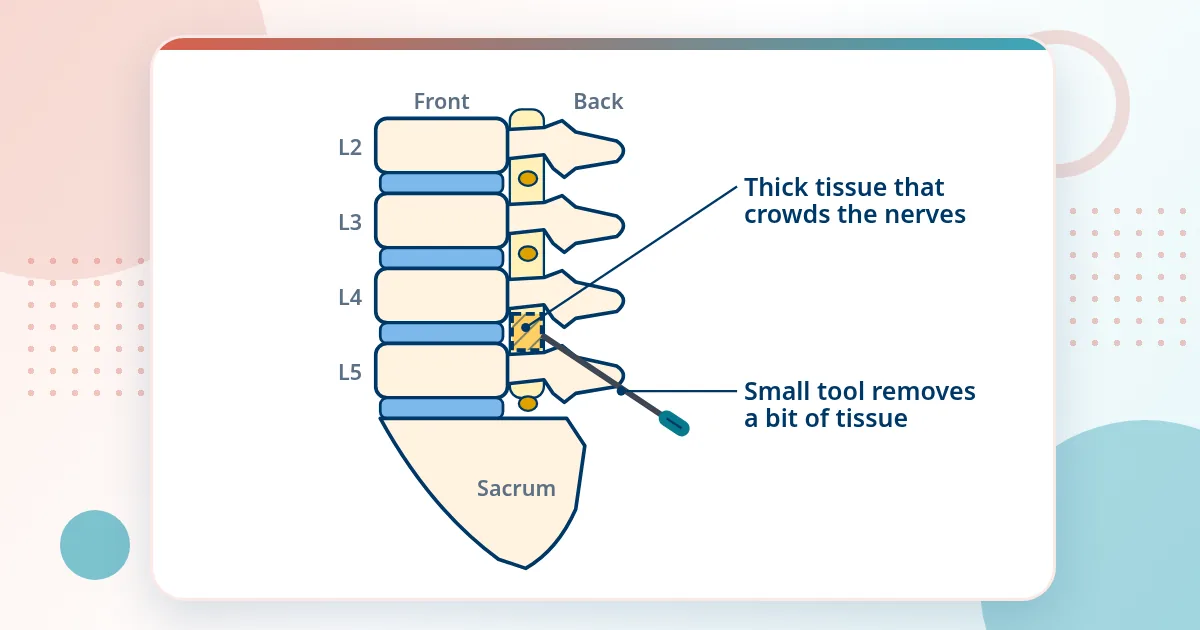
The mild® procedure (minimally invasive lumbar decompression) is an outpatient treatment for some people with lumbar spinal stenosis. In many people with stenosis, a ligament in the back of the spine gets thick over time and crowds the nerves. The mild® procedure removes small pieces of that thickened ligament to make more room for the nerves. It is done through a very small opening, and no implant is left behind. For some people, it may help them stand and walk longer with less leg pain.
Watch: how the MILD procedure works
Video: “MILD Procedure Patient Education Minimally Invasive Lumbar Decompression | Innovative Pain and Spine” from Joseph Amos, MD MBA on YouTube. The animation is the mild® patient video from Vertos Medical (now part of Stryker), the maker of the mild® tools; it was posted to YouTube by another pain practice. It loads from youtube-nocookie.com only when you press play. Shown for general education; GSMC did not produce it. Watch on YouTube
What it is
The ligamentum flavum is a ligament that runs along the back of the spinal canal. When it thickens, it can narrow the canal and press on nerves. In the mild® procedure, your physician uses small tools passed through a tiny port to trim away part of this ligament.
mild® is a registered trademark of Vertos Medical. The tools used for the procedure are made by Vertos Medical.
Who it's for
The mild® procedure may help people who have:
- Lumbar spinal stenosis with a thickened ligamentum flavum seen on MRI or CT
- Pain, heaviness or tingling in the legs or buttocks when standing or walking
- Relief when sitting or leaning forward
- Symptoms that have not improved enough with physical therapy, medicines or injections
What the procedure involves, step by step
- Before: we review your MRI or CT to measure the ligament and confirm that it is part of the problem. We also review your medicines, including blood thinners.
- Getting ready: you lie on your stomach. The skin is numbed with local anesthetic, and light sedation is often used.
- Access: using live X-ray guidance and contrast dye, your physician places a small port through a tiny opening in the low back. The opening is about the size of a baby aspirin.
- Decompression: small tools are passed through the port to remove pieces of the thickened ligament.
- Finish: the port is removed. Stitches are usually not needed, and a small bandage is placed. The procedure often takes less than an hour.
- Going home: most people go home the same day.
Recovery and what to expect
- Soreness at the site for a few days is common.
- Many people return to light activity within a day or two.
- You may be asked to avoid heavy lifting for a short time.
- Some people notice a change in walking or standing soon after. For others it takes longer, and some people do not improve.
- Physical therapy or a walking program may help you build up your activity.
Candidacy: who may or may not be a good fit
May be a good fit: people whose stenosis is caused at least in part by a thickened ligament, and whose leg symptoms with walking match their imaging.
May not be a good fit: people whose narrowing is mainly from a disc herniation or bone, people with significant instability or a large slip of one bone on another, people with an active infection or a bleeding problem, or people whose main problem is back pain without leg symptoms. Your exam and imaging decide whether mild® is a reasonable option.
Risks in brief
Risks include soreness at the site, bleeding, infection and a short-term increase in pain. Rarely, nerve injury or a spinal fluid leak can occur. Symptoms may not improve, or may come back over time. We will review your specific risks with you.
Alternatives
Other options may include physical therapy, medicines, epidural steroid injections, an interspinous spacer, spinal cord stimulation or decompression surgery (such as a laminectomy). Having the mild® procedure does not rule out other treatments later.
Frequently asked questions
Is the mild® procedure surgery?
It is a minimally invasive procedure done through a very small port. It is usually done with local anesthetic and light sedation, and no implant is left behind.
How big is the opening?
The opening is very small, about the size of a baby aspirin. Stitches are usually not needed.
How long does it take?
The procedure often takes less than an hour. Most people go home the same day.
Will I need a special MRI?
We need recent imaging that shows the ligament. If your MRI or CT is older, we may ask for a new one.
Can I have other treatments later?
Yes. The mild® procedure does not rule out other options, such as an interspinous spacer or surgery, if they are needed later.
How is mild® different from an interspinous spacer?
The mild® procedure removes part of a thickened ligament and leaves nothing behind. A spacer is a small implant that holds space open between two bones.
Understanding Insurance Coverage for the MILD Procedure
If you're living with lumbar spinal stenosis, you may have questions about coverage for the MILD® procedure as well as how it works. At Garden State Medical Center, we want you to have clear answers before you decide on any treatment.
Coverage for MILD depends on your insurance plan. Some plans ask for prior authorization, records of treatments you've already tried, or other steps before they approve the procedure. Our team can help you understand what your plan requires and help with the paperwork.
Garden State Medical Center participates with all Aetna plans, including Aetna HMO. If you have Aetna or another insurer, call us and we'll help check your benefits before your visit. Aetna HMO plans may require a referral from your primary care physician.
If leg or back pain from spinal stenosis is limiting how far you can walk or stand, we're here to help. Call 732-202-3000 to check your coverage or schedule a consultation with Dr. Dharam Mann.
Insurance
Garden State Medical Center participates with all Aetna plans, including Aetna HMO, and works with many other insurance carriers. Coverage for any procedure depends on your plan, and prior authorization may be required. Our staff is happy to help verify your benefits and explain what to expect before treatment. Please call 732-202-3000 with your insurance card handy, and we'll help you take the next step.
Where to get the mild® procedure near you
GSMC has 7 offices in Ocean and Monmouth County, with one phone number for all of them. Call 732-202-3000 to confirm which office offers the mild® procedure.
- Toms River1314 Hooper Ave, 1st Floor, Toms River, NJ 08753Get directions · 732-202-3000
- Brick1608 NJ-88, Suite 102, Brick Township, NJ 08724Get directions · 732-202-3000
- Whiting1100 NJ-70, Entrance B, Whiting, NJ 08759Get directions · 732-202-3000
- Barnegat249 S Main St, Suite 5, Barnegat Township, NJ 08005Get directions · 732-202-3000
- Manahawkin1109 Beacon Ave, Manahawkin, NJ 08050Get directions · 732-202-3000
- Freehold322 Professional View Dr, 300 Building, 2nd Floor, Freehold, NJ 07728Get directions · 732-202-3000
- West Long Branch100 NJ-36, Suite 1K, West Long Branch, NJ 07764Get directions · 732-202-3000
Patients come to us from Toms River, Brick, Lakewood, Jackson, Manchester, Whiting, Lacey, Barnegat, Manahawkin, Long Beach Island, Little Egg Harbor, Tuckerton, Freehold, Howell, Marlboro, Manalapan, Wall, West Long Branch, Long Branch, Eatontown, Red Bank, Neptune, Point Pleasant and other towns across Ocean and Monmouth County.
Nearby hospitals and imaging centers
Our offices are a short drive from these area hospitals and imaging centers:
- Community Medical Center (Toms River), near our Toms River office
- Ocean University Medical Center (Brick), near our Brick office
- Monmouth Medical Center Southern Campus (Lakewood), near our Brick office
- Southern Ocean Medical Center (Manahawkin), near our Manahawkin office
- CentraState Medical Center (Freehold), near our Freehold office
- Monmouth Medical Center (Long Branch), near our West Long Branch office
- Jersey Shore University Medical Center (Neptune), near our West Long Branch office
- Riverview Medical Center (Red Bank), near our West Long Branch office
- University Radiology (Toms River), near our Toms River office
- New Jersey Imaging Network - Toms River East (Toms River), near our Toms River office
- Atlantic Medical Imaging (Brick, Toms River, Manahawkin and Wall)
Listed for directions only.
Book an appointment
One phone number for all 7 GSMC offices in Ocean and Monmouth County.
Our offices
- Whiting
- Toms River (1314 Hooper Ave)
- Brick
- Barnegat
- Manahawkin
- Freehold (322 Professional View Dr)
- West Long Branch
Telehealth visits are available for second opinions and imaging reviews only, by phone. Please call 732-202-3000 to book one.
This page is general patient education and does not replace advice from your own clinician. Individual results vary, and no outcome can be promised.