
Patient brochure (PDF, Letter) Print shop version (with bleed) · All PNS brochures
Overview
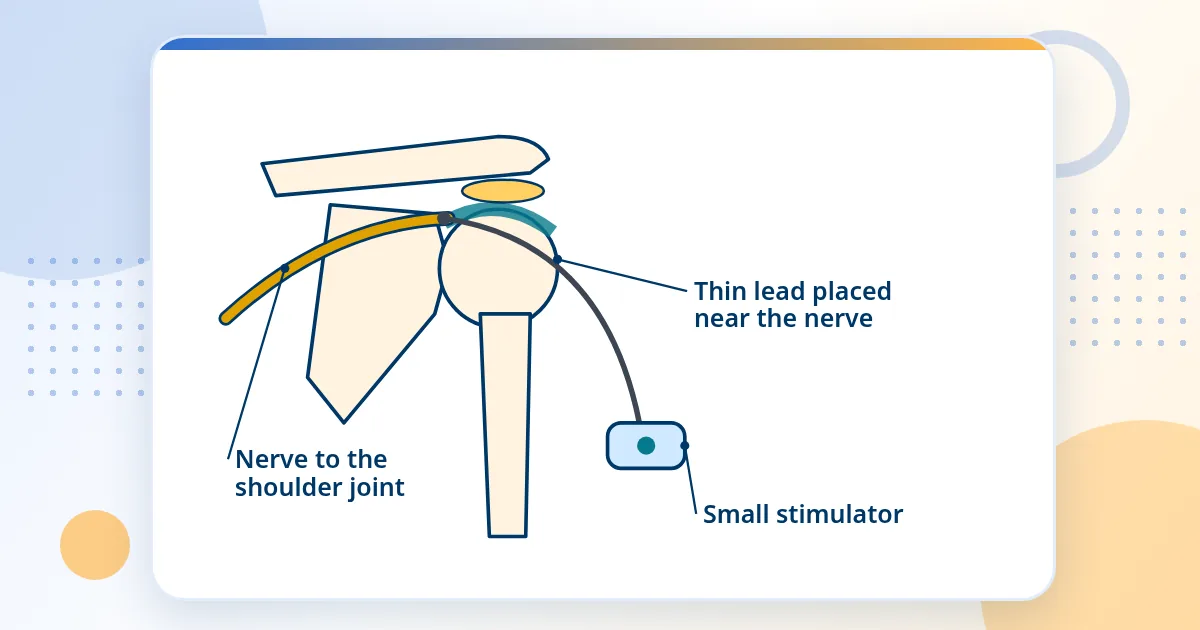
Peripheral nerve stimulation, or PNS, is a minimally invasive treatment for some types of long-lasting pain. For the shoulder, a very thin wire is placed near the nerves that carry pain signals from the shoulder, most often the suprascapular and axillary nerves. The wire sends mild electrical pulses that may change how pain signals reach the brain. PNS may help some people with chronic shoulder pain that has not improved with other care. It does not repair the shoulder, and results vary.
GSMC is led by Dr. Dharam Mann, who completed fellowships in pain management, cardiac anesthesia and critical care at Massachusetts General Hospital/Harvard.
Watch: how peripheral nerve stimulation works
Video: “An Overview of SPRINT PNS” from SPR on YouTube. SPRINT PNS is one brand of peripheral nerve stimulation system, made by SPR Therapeutics. GSMC may recommend a different system based on your needs. It loads from youtube-nocookie.com only when you press play. Shown for general education; GSMC did not produce it. Watch on YouTube
What it is
In PNS, one or more thin leads (wires) are placed through a needle near a target nerve. The leads connect to a small stimulator. The suprascapular nerve carries much of the feeling from the shoulder joint, and the axillary nerve supplies the front and side of the shoulder.
There are two general types of systems:
- Temporary systems: the lead is worn for a set time, often about 60 days, and then removed in the office.
- Long-term (implanted) systems: after a successful trial, a lead and a small device are placed under the skin and can stay in place long term.
Several companies make PNS systems. Our physicians choose a system based on your needs, and no brand can promise a result.
Who it's for
PNS for the shoulder may help people who have:
- Chronic shoulder pain from arthritis, rotator cuff problems or other causes that has not improved enough with therapy, medicines or injections
- Ongoing shoulder pain after shoulder surgery
- Shoulder pain after a stroke
- People who are not ready for, or are not good candidates for, shoulder surgery
What the procedure involves, step by step
- Before: we review your history, exam and imaging. A test nerve block may help show whether these nerves carry your pain. Some medicines, such as blood thinners, may need to be paused with approval from the prescribing doctor.
- Placement: in an outpatient visit, the skin is numbed. Using ultrasound guidance, your physician places one or more thin leads through a needle near the suprascapular and/or axillary nerves.
- Setup: the lead connects to a small stimulator. Your care team adjusts the settings to cover your pain area. Most people feel a light tingling or pulsing.
- Use at home: you use the stimulator during daily life and track your pain and movement.
- Follow-up: with a temporary system, the lead is removed in the office at the end of the treatment period. If a long-term system is chosen, it is placed in a separate procedure.
Recovery and what to expect
- Most people go home the same day and return to light activity within a day or two.
- Keep the lead site clean and dry, and avoid heavy reaching or lifting with that arm as advised.
- Some people notice a change in pain during treatment, which may help them do more in therapy. Others do not improve.
- With temporary systems, some people have relief that lasts after the lead is removed, and others do not.
Candidacy: who may or may not be a good fit
May be a good fit: people with chronic shoulder pain that has not improved enough with other care.
May not be a good fit: people with an infection near the shoulder, a bleeding problem, certain implanted heart devices, skin problems that limit the use of adhesive, or a shoulder problem that needs surgery first, such as some full-thickness rotator cuff tears or an unstable shoulder. Research on PNS for shoulder pain is still growing.
Risks in brief
Risks include skin irritation from the bandage or adhesive, infection at the lead site, bleeding or bruising, and the lead moving or breaking. Small lead fragments can, rarely, remain under the skin. Pain may not improve. We will review your specific risks.
Alternatives
Other options may include physical therapy, medicines, shoulder joint or bursa injections, nerve blocks, PRP (self-pay in most cases), radiofrequency ablation for some people or a referral for shoulder surgery.
Frequently asked questions
Which nerves are targeted for shoulder PNS?
Usually the suprascapular nerve and sometimes the axillary nerve. These nerves carry much of the pain signal from the shoulder.
Will I feel the stimulation?
Many people feel a light tingling or pulsing. Some settings are barely felt.
Is PNS permanent?
It depends on the system. Some are used for about 60 days and then removed. Others can stay in place long term after a successful trial.
Can I keep doing physical therapy?
Usually yes. Some people find PNS helps them do more in therapy. Ask your care team before starting new activities.
Will PNS fix a rotator cuff tear?
No. PNS may help with pain, but it does not repair a tear or other damage.
Can I still have shoulder surgery later?
Yes. PNS does not rule out surgery later.
Insurance
GSMC participates with all Aetna plans, including Aetna HMO, and with many other insurance plans. Coverage for a specific procedure depends on your plan and may need prior authorization; call 732-202-3000 to verify. Our team can help check your benefits before treatment.
Where to get PNS for shoulder pain near you
GSMC has 7 offices in Ocean and Monmouth County, with one phone number for all of them. Call 732-202-3000 to confirm which office offers PNS for shoulder pain.
- Toms River1314 Hooper Ave, 1st Floor, Toms River, NJ 08753Get directions · 732-202-3000
- Brick1608 NJ-88, Suite 102, Brick Township, NJ 08724Get directions · 732-202-3000
- Whiting1100 NJ-70, Entrance B, Whiting, NJ 08759Get directions · 732-202-3000
- Barnegat249 S Main St, Suite 5, Barnegat Township, NJ 08005Get directions · 732-202-3000
- Manahawkin1109 Beacon Ave, Manahawkin, NJ 08050Get directions · 732-202-3000
- Freehold322 Professional View Dr, 300 Building, 2nd Floor, Freehold, NJ 07728Get directions · 732-202-3000
- West Long Branch100 NJ-36, Suite 1K, West Long Branch, NJ 07764Get directions · 732-202-3000
Patients come to us from Toms River, Brick, Lakewood, Jackson, Manchester, Whiting, Lacey, Barnegat, Manahawkin, Long Beach Island, Little Egg Harbor, Tuckerton, Freehold, Howell, Marlboro, Manalapan, Wall, West Long Branch, Long Branch, Eatontown, Red Bank, Neptune, Point Pleasant and other towns across Ocean and Monmouth County.
Nearby hospitals and imaging centers
Our offices are a short drive from these area hospitals and imaging centers:
- Community Medical Center (Toms River), near our Toms River office
- Ocean University Medical Center (Brick), near our Brick office
- Monmouth Medical Center Southern Campus (Lakewood), near our Brick office
- Southern Ocean Medical Center (Manahawkin), near our Manahawkin office
- CentraState Medical Center (Freehold), near our Freehold office
- Monmouth Medical Center (Long Branch), near our West Long Branch office
- Jersey Shore University Medical Center (Neptune), near our West Long Branch office
- Riverview Medical Center (Red Bank), near our West Long Branch office
- University Radiology (Toms River), near our Toms River office
- New Jersey Imaging Network - Toms River East (Toms River), near our Toms River office
- Atlantic Medical Imaging (Brick, Toms River, Manahawkin and Wall)
Listed for directions only.
Book an appointment
One phone number for all 7 GSMC offices in Ocean and Monmouth County.
Our offices
- Whiting
- Toms River (1314 Hooper Ave)
- Brick
- Barnegat
- Manahawkin
- Freehold (322 Professional View Dr)
- West Long Branch
Telehealth visits are available for second opinions and imaging reviews only, by phone. Please call 732-202-3000 to book one.
This page is general patient education and does not replace advice from your own clinician. Individual results vary, and no outcome can be promised.