

Printable patient guide PDF: Print at home/office (Letter) · PDF: Print shop (with bleed)
Overview
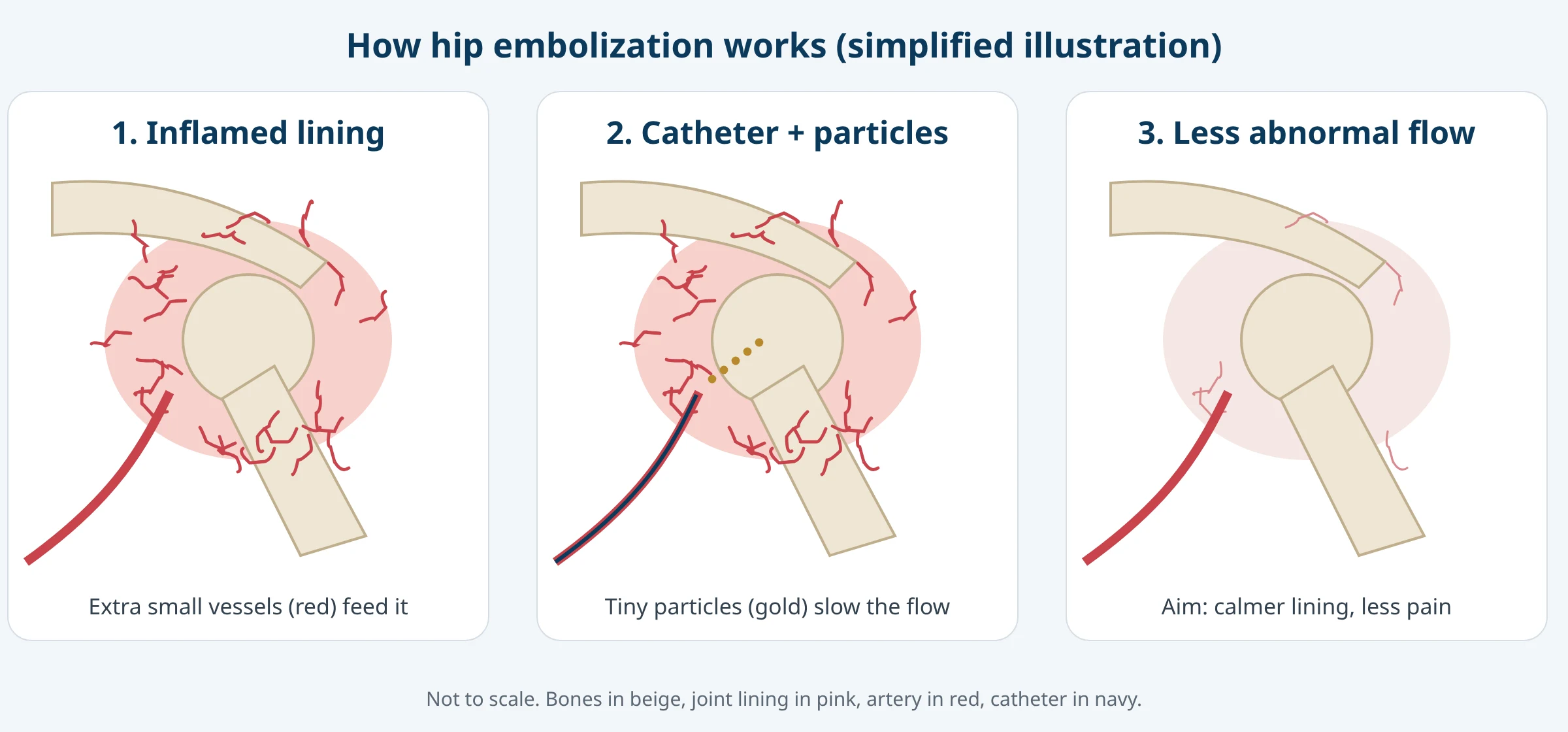
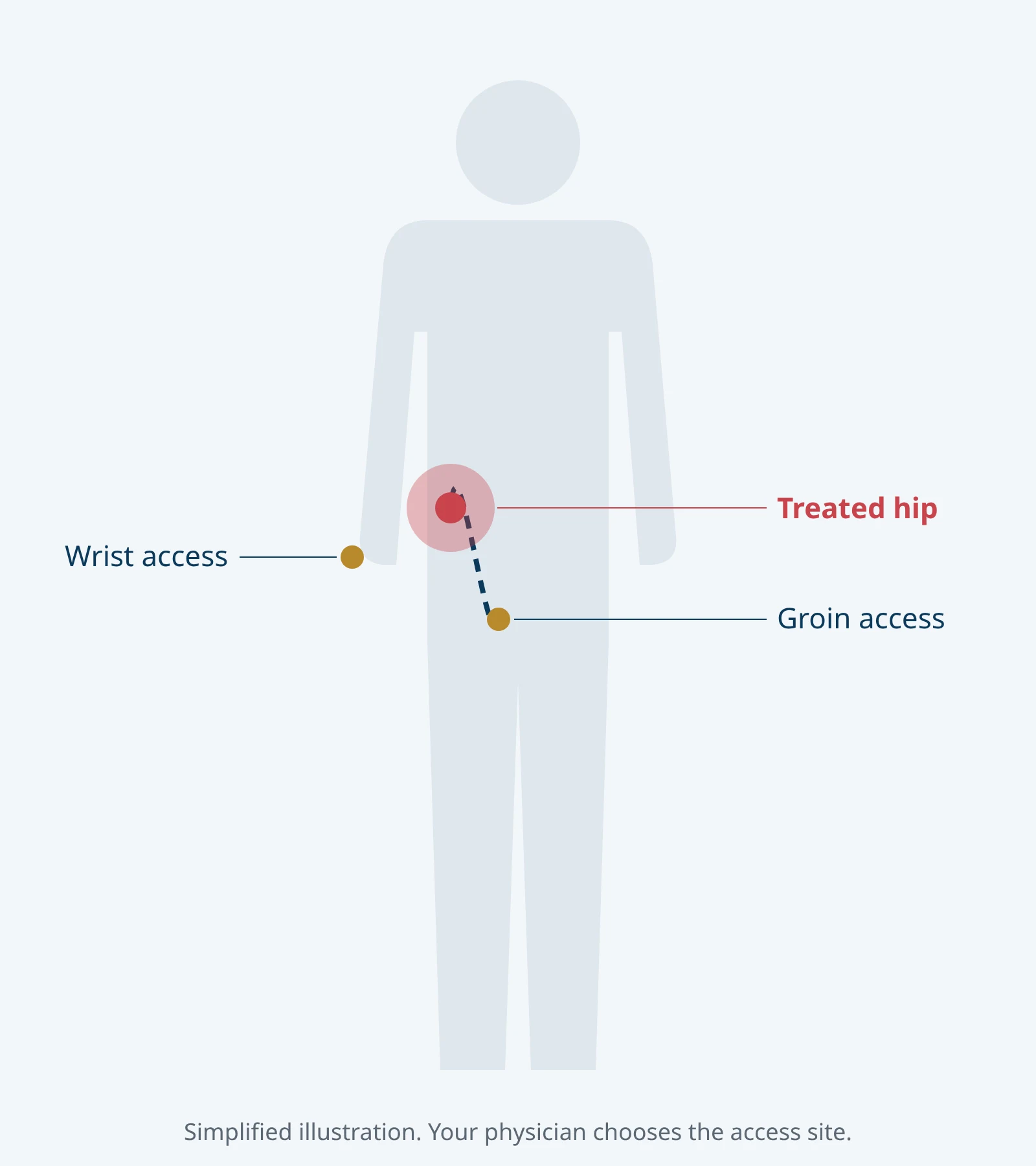
In hip arthritis and some other long-lasting hip problems, the tissue around the joint can become inflamed and grow extra small blood vessels. This extra blood flow is linked with pain. Hip embolization slows that blood flow. A very thin tube (catheter) is placed at the wrist or groin and guided to small arteries around the hip, where tiny particles are released. There is no cut into the hip. It does not repair cartilage. Research on hip embolization is earlier than for the knee.
GSMC providers select patients and complete the evaluation and workup at any of our 7 offices. Our team reviews long-lasting hip pain and explains every option, including whether hip embolization may fit. The procedure itself is performed by Dr. Douglas Gibbens, an interventional radiologist who works with our team, at Manchester Surgery Center (1100 Route 70 West, Whiting) or Bey Lea Surgery Center (54 Bey Lea Road, Building 2, Toms River).
Why hip pain can last: inflammation and new blood vessels
Hip osteoarthritis wears down the cartilage of the ball-and-socket joint, and like the knee, the joint lining and nearby tissue can become inflamed. Inflamed tissue can grow extra small blood vessels (neovessels), with sensory nerve fibers growing alongside them.
Pain on the outside of the hip (greater trochanteric pain syndrome) often comes from inflamed tendons and bursae near the bony point of the hip, and may show a similar pattern of abnormal vessels.
Hip embolization slows the abnormal blood flow in small branches around the hip, most often from the lateral circumflex femoral artery. The aim is to calm inflammation and pain. It does not regrow cartilage or change the shape of the joint. Research on the hip is at an earlier stage than for the knee.
Who may be a candidate
Hip embolization may help people who have:
- Hip osteoarthritis pain for 3 months or more
- Some chronic pain on the outside of the hip (greater trochanteric pain), after an evaluation
- Pain that has not improved enough with exercise, physical therapy, medicines or injections
- People who want to avoid or delay hip replacement, or who are not candidates for it
Your history, exam and imaging help decide whether it fits you. Results vary.
Who may not be a good fit
Embolization may not be right for people with:
- Infection in or near the hip
- A hip replacement on that side
- Collapse of the hip bone (avascular necrosis) or very advanced arthritis that may need a surgical evaluation
- Pain mainly from the low back or nerves
- Serious kidney disease, a severe allergy to contrast dye or a bleeding problem
- Pregnancy
If another cause of pain is found, we will explain other options or coordinate a referral.
Your evaluation at any GSMC office
GSMC providers select patients and complete the evaluation and workup at any of our 7 offices, so you can start at the office closest to you. Your visit typically includes:
- A review of your symptoms, how long they have lasted and what you have already tried
- A physical exam of the hip, and of nearby areas that can refer pain (such as the low back)
- A review of recent X-rays, and MRI or ultrasound if needed
- Blood work to check kidney function, if needed, because the procedure uses contrast dye
- A review of medicines, especially blood thinners, and allergies
- An honest talk about all of your options, expected results, risks and insurance coverage
Procedure day, step by step
The procedure is done as an outpatient at Manchester Surgery Center (1100 Route 70 West, Whiting) or Bey Lea Surgery Center (54 Bey Lea Road, Building 2, Toms River) by Dr. Douglas Gibbens, an interventional radiologist who works with our team.
- Check-in: Arrive at the time given, with your driver. Follow the eating and medicine instructions we give you.
- Preparation: A nurse reviews your health, places an IV and checks your vital signs.
- Sedation and numbing: You usually receive light sedation. The skin at the wrist or groin is numbed.
- Access: A very thin catheter is placed into an artery through a small opening.
- Mapping: Using live X-ray and contrast dye, the catheter is guided to the small arteries around the hip and the abnormal vessels are found.
- Embolization: Tiny particles are released into the target branches to slow the abnormal flow.
- Finish: The catheter is removed and pressure or a closure device is used. The procedure often takes about 1 to 2 hours.
- Recovery room: You rest while the team monitors you and the access site, then you go home the same day with written instructions.
Recovery timeline
| When | What to expect |
|---|---|
| Procedure day | Rest and monitoring after the procedure, then home with a driver. Keep the access site dry and covered; rest the arm or leg used. |
| Days 1-7 | Light walking and daily tasks are usually fine. Avoid heavy lifting, hard exercise and soaking in a tub or pool with the access site. Mild soreness in the joint or a bruise at the wrist or groin is common. |
| Weeks 2-6 | Most people are back to normal activities. Some notice pain starting to ease; for others, change is slower. Some people see a short-term skin color change over the joint that usually fades. Keep up with exercise or physical therapy. |
| About 3 months | A follow-up visit to review pain, function and goals. If embolization did not help enough, we talk through next options. |
Risks, explained
Every procedure has risks. Here is what they mean in plain language:
| Risk | What it means |
|---|---|
| Access site bruising or bleeding | A bruise or small lump at the wrist or groin is common and usually fades. Larger bleeding is uncommon; pressure or a closure device is used to prevent it. |
| Skin color change over the joint | Some people notice a temporary patchy discoloration or tenderness of the skin over the joint. It usually fades over days to weeks. |
| Particles reaching an unintended area | Rarely, particles can reach small vessels that were not targeted, which may irritate or injure skin or other tissue. Careful imaging during the procedure is used to lower this risk. |
| Contrast dye reactions and kidneys | The X-ray dye can cause an allergic reaction or strain the kidneys. We check your kidney function and allergies first. |
| Infection | Uncommon. Keep the access site clean and call us for fever or redness. |
| No improvement | Pain may not improve, or may return over time. Embolization does not rule out other treatments later. |
Our team will review your specific risks with you before you decide.
Call us for bleeding or a growing lump at the access site, fever over 101°F, a cold, pale or numb hand or foot, or skin over the joint that becomes dark, blistered or open. Call 911 for chest pain or trouble breathing.
How it compares with other options
Embolization is one option among several. Many people use more than one over time.
| Option | How it works | Good to know |
|---|---|---|
| Exercise and physical therapy | Strength, motion and walking tolerance | First-line; continues after any procedure |
| Hip joint or bursa steroid injection | Short-term reduction of inflammation | Image-guided; relief is often temporary |
| PRP injection | Uses your own platelets | Usually self-pay; evidence still developing |
| Radiofrequency ablation of hip nerves | Heat calms nerves that carry hip pain | Outpatient, needle-based |
| Hip embolization | Reduces abnormal blood flow linked with inflammation | Catheter-based; early research; coverage varies |
| Hip replacement | Replaces the worn joint | A surgical option an orthopedic surgeon may discuss; we can coordinate a referral |
What the research shows
Research on hip embolization is at an early stage.
- A 2026 study from Berlin (Fleckenstein and colleagues, Cardiovascular and Interventional Radiology) looked back at 41 people with hip osteoarthritis that had not improved with other care. Pain and hip function scores improved at 12 months, there were no major or moderate side effects, and a small number of people went on to have hip replacement. There was no comparison group.
- Other early studies, including the HipE study (Cardiovascular and Interventional Radiology, 2026), have looked at hip osteoarthritis and pain on the outside of the hip.
- A 2025 expert-panel review in the American Journal of Roentgenology summarized embolization for musculoskeletal pain across several joints.
What this means for you: hip embolization is a newer option. It may be worth discussing if other treatments have not helped and you want to avoid or delay hip replacement, or are not a candidate, but the evidence is limited and results vary.
Sources are listed in our referring physician guide and include peer-reviewed studies found on PubMed.
Insurance and cost
Coverage for embolization varies. Many insurers consider genicular artery embolization, and embolization for the shoulder or hip, investigational, so it may not be covered. Our team will check your plan and talk with you about costs before anything is scheduled.
- Our team checks your benefits and whether prior authorization is needed before anything is scheduled.
- If your plan does not cover it, we will explain the self-pay cost in writing before you decide.
- Covered alternatives, such as physical therapy, injections or nerve ablation, are always discussed.
Call 732-202-3000 to verify your benefits. See accepted insurance.
Frequently asked questions
Is hip embolization surgery?
No. It is a minimally invasive procedure done through a thin catheter at the wrist or groin. There is no cut into the hip.
Does it fix the hip?
No. It does not repair cartilage. It aims to reduce the abnormal blood flow linked with inflammation and pain.
How soon might I feel a change?
If it helps, the change often builds over several weeks. Results vary, and some people notice little or no change.
Will I stay overnight?
Most people go home the same day after a period of rest and monitoring. Plan to have a driver.
Can I still have other treatments later?
Yes. Embolization does not rule out physical therapy, injections or joint replacement later.
Does insurance cover it?
Coverage for embolization varies. Many insurers consider genicular artery embolization, and embolization for the shoulder or hip, investigational, so it may not be covered. Our team will check your plan and talk with you about costs before anything is scheduled.
Who is a good candidate for hip embolization?
Adults with hip osteoarthritis or pain on the outside of the hip lasting at least 3 months that has not improved with therapy, medicines or injections, especially people who want to avoid or delay hip replacement or are not candidates for it.
Is hip embolization new?
Yes. It is newer than knee embolization, and research is at an early stage.
Does it help bursitis on the outside of the hip?
Some early studies included pain on the outside of the hip (greater trochanteric pain syndrome). Our team will review whether your pain pattern fits.
Does hip embolization hurt?
You usually get light sedation and numbing medicine at the access site. Some soreness for a few days is common.
What if I already had a hip replacement?
Hip embolization is not used for a hip that has been replaced. Pain after a replacement needs a different evaluation.
Where is the procedure done?
Evaluation and workup take place at any of our 7 offices. The procedure is done as an outpatient at Manchester Surgery Center in Whiting or Bey Lea Surgery Center in Toms River by Dr. Douglas Gibbens, an interventional radiologist who works with our team.
What should I bring to my consultation?
Your X-ray or MRI reports or images, a list of your medicines (including blood thinners), any allergies, and your insurance card.
Who performs the procedure
Douglas Gibbens, MD, interventional radiology
Dr. Douglas Gibbens performs embolization for GSMC patients at Manchester Surgery Center and Bey Lea Surgery Center. Evaluation, workup and follow-up are with GSMC providers at any of our 7 offices.
Where to schedule a consultation
Consultations are available at all 7 GSMC offices. Procedures are performed at Manchester Surgery Center (1100 Route 70 West, Whiting) or Bey Lea Surgery Center (54 Bey Lea Road, Building 2, Toms River).
- Whiting1100 NJ-70, Entrance B, Whiting, NJ 08759732-202-3000
- Toms River1314 Hooper Ave, 1st Floor, Toms River, NJ 08753732-202-3000
- Brick1608 NJ-88, Suite 102, Brick Township, NJ 08724732-202-3000
- Barnegat249 S Main St, Suite 5, Barnegat Township, NJ 08005732-202-3000
- Manahawkin1109 Beacon Ave, Manahawkin, NJ 08050732-202-3000
- Freehold322 Professional View Dr, 300 Building, 2nd Floor, Freehold, NJ 07728732-202-3000
- West Long Branch100 NJ-36, Suite 1K, West Long Branch, NJ 07764732-202-3000
Request a consultation
Bring a list of your medicines and any recent X-rays or MRI reports.
This page is general patient education and does not replace advice from your own clinician. Individual results vary, and no outcome can be promised. Insurance coverage varies.