
Overview
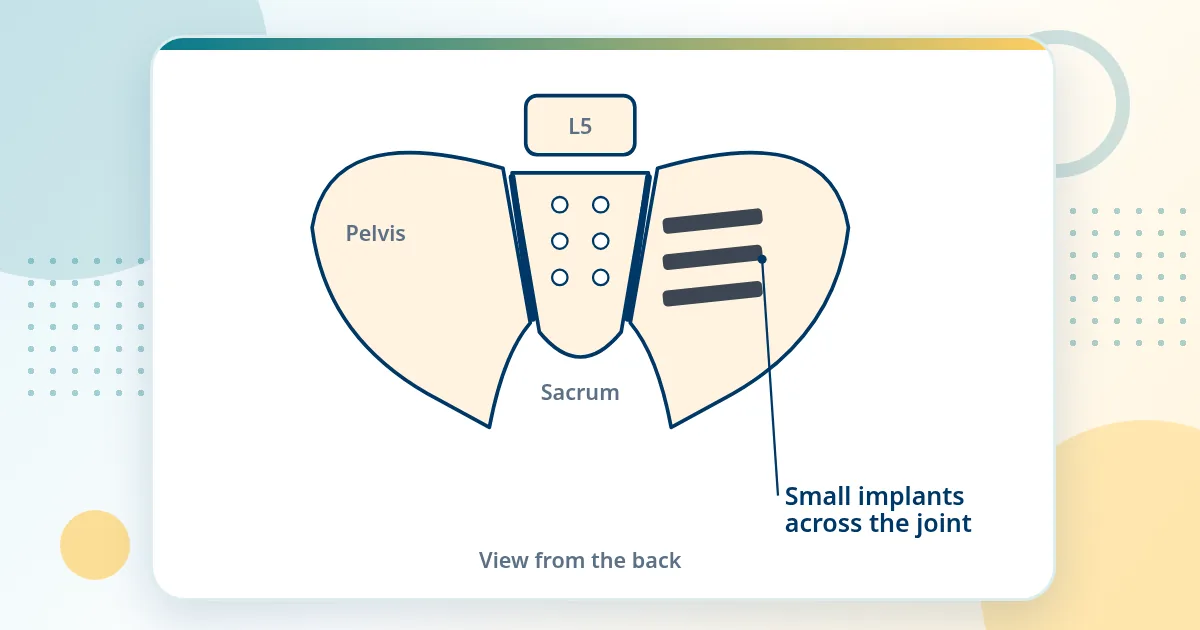
Your sacroiliac (SI) joints connect the base of your spine to your pelvis. When one of these joints is worn, loose or inflamed, it can cause ongoing pain in the low back, buttock or hip. Many people improve with therapy, a belt, injections or radiofrequency treatment. For some people whose pain continues, minimally invasive SI joint fusion may help. Through a small cut, small implants are placed across the joint to hold it steady so it can fuse over time. At GSMC, this procedure is done at our own surgery center for patients who are a good fit.
Watch: how SI Joint Fusion works
Video: “iFuse Video Sacroiliac Joint Fusion” from SI-BONE on YouTube. It loads from youtube-nocookie.com only when you press play. Shown for general education; GSMC did not produce it. Watch on YouTube
What it is
"Fusion" means helping two bones grow together so they no longer move against each other. In minimally invasive SI joint fusion, small implants are placed across the joint between the sacrum and the pelvis (ilium). The implants are designed to steady the joint right away, and over time bone may grow onto or through them.
There are different approaches. In a lateral approach, implants are placed from the side of the hip. In a posterior approach, they are placed from the back. Your surgeon will explain which approach fits you.
Who it's for
SI joint fusion may be considered for people who have:
- Ongoing low back, buttock or hip pain from the SI joint
- Exam tests that point to the SI joint
- Clear short-term relief from a diagnostic SI joint injection
- Pain that has not improved after at least six months of conservative care, such as therapy, medicines and injections
What the procedure involves, step by step
- Confirming the source: we confirm the SI joint is the pain source with an exam, imaging and usually a diagnostic SI joint injection.
- Before surgery: you have pre-surgery testing and a review of your health and medicines.
- Anesthesia: the procedure is done at GSMC's surgery center under anesthesia.
- Small incision: the surgeon makes a small cut over the buttock or side of the hip.
- Implants: using live X-ray guidance, small implants are placed across the joint.
- Closing: the incision is closed and covered.
- Going home: many people go home the same day after a period of monitoring.
Recovery and what to expect
- You will likely limit weight on the treated side for a period, often a few weeks, using crutches or a walker.
- Soreness at the incision is common for the first several days.
- Physical therapy usually starts after the first few weeks.
- Most people return to activity slowly over several weeks to months.
- Fusion takes time. Your surgeon will give you a written plan and see you for follow-up visits.
Candidacy: who may or may not be a good fit
May be a good fit: people with confirmed SI joint pain that has not improved with at least six months of conservative care.
May not be a good fit: people whose pain comes mainly from another source (such as the hip or lumbar spine), people with an active infection, a tumor or fracture in the area, severe osteoporosis, an allergy to the implant materials, or health problems that make anesthesia unsafe. Pregnancy is also a reason to wait.
Risks in brief
SI joint fusion is still a surgical procedure. Risks include infection, bleeding, wound problems, nerve irritation, implant placement that is not ideal, ongoing pain and the need for another surgery. Anesthesia also carries risks. Your surgeon will review these with you.
Alternatives
Other options may include physical therapy, an SI belt, medicines, SI joint injections and radiofrequency ablation of the nerves to the SI joint. You can also ask for a second opinion.
Frequently asked questions
How do I know my pain is from the SI joint?
A combination of exam tests and a diagnostic SI joint injection is commonly used to help confirm it.
Is SI joint fusion major surgery?
It is done through a small incision, but it is still surgery with anesthesia and a recovery period.
Where is the procedure done?
At GSMC, minimally invasive SI joint fusion is done at our own surgery center for patients who are a good fit.
Will I stay overnight?
Many people go home the same day. Your surgeon will let you know what to expect for you.
How long is recovery?
Most people limit weight on the treated side for a few weeks and then slowly return to activity over several weeks to months.
Can the implants be removed?
The implants are meant to stay in place. In rare cases, another surgery may be needed to adjust or remove them.
Insurance
GSMC participates with all Aetna plans, including Aetna HMO, and with many other insurance plans. Coverage for a specific procedure depends on your plan and may need prior authorization; call 732-202-3000 to verify. Our team can help check your benefits before treatment.
Where to get SI joint fusion near you
GSMC has 7 offices in Ocean and Monmouth County, with one phone number for all of them. Call 732-202-3000 to confirm which office offers SI joint fusion.
- Toms River1314 Hooper Ave, 1st Floor, Toms River, NJ 08753Get directions · 732-202-3000
- Brick1608 NJ-88, Suite 102, Brick Township, NJ 08724Get directions · 732-202-3000
- Whiting1100 NJ-70, Entrance B, Whiting, NJ 08759Get directions · 732-202-3000
- Barnegat249 S Main St, Suite 5, Barnegat Township, NJ 08005Get directions · 732-202-3000
- Manahawkin1109 Beacon Ave, Manahawkin, NJ 08050Get directions · 732-202-3000
- Freehold322 Professional View Dr, 300 Building, 2nd Floor, Freehold, NJ 07728Get directions · 732-202-3000
- West Long Branch100 NJ-36, Suite 1K, West Long Branch, NJ 07764Get directions · 732-202-3000
Patients come to us from Toms River, Brick, Lakewood, Jackson, Manchester, Whiting, Lacey, Barnegat, Manahawkin, Long Beach Island, Little Egg Harbor, Tuckerton, Freehold, Howell, Marlboro, Manalapan, Wall, West Long Branch, Long Branch, Eatontown, Red Bank, Neptune, Point Pleasant and other towns across Ocean and Monmouth County.
Nearby hospitals and imaging centers
Our offices are a short drive from these area hospitals and imaging centers:
- Community Medical Center (Toms River), near our Toms River office
- Ocean University Medical Center (Brick), near our Brick office
- Monmouth Medical Center Southern Campus (Lakewood), near our Brick office
- Southern Ocean Medical Center (Manahawkin), near our Manahawkin office
- CentraState Medical Center (Freehold), near our Freehold office
- Monmouth Medical Center (Long Branch), near our West Long Branch office
- Jersey Shore University Medical Center (Neptune), near our West Long Branch office
- Riverview Medical Center (Red Bank), near our West Long Branch office
- University Radiology (Toms River), near our Toms River office
- New Jersey Imaging Network - Toms River East (Toms River), near our Toms River office
- Atlantic Medical Imaging (Brick, Toms River, Manahawkin and Wall)
Listed for directions only.
Book an appointment
One phone number for all 7 GSMC offices in Ocean and Monmouth County.
Our offices
- Whiting
- Toms River (1314 Hooper Ave)
- Brick
- Barnegat
- Manahawkin
- Freehold (322 Professional View Dr)
- West Long Branch
Telehealth visits are available for second opinions and imaging reviews only, by phone. Please call 732-202-3000 to book one.
This page is general patient education and does not replace advice from your own clinician. Individual results vary, and no outcome can be promised.