
Sacroiliac Joint Pain: Causes and Treatment
Oct 17, 2026
By the GSMC pain management team
Pain low in the back, on one side, that spreads into the buttock or hip is not always a spine problem. In up to about a quarter of people with chronic low back pain, the source is the sacroiliac (SI) joint, where the spine meets the pelvis. This guide explains how SI joint pain is found and treated, step by step, from home care to injections, radiofrequency ablation and minimally invasive SI joint fusion.
GSMC is led by Dr. Dharam Mann, who completed fellowships in pain management, cardiac anesthesia and critical care at Massachusetts General Hospital/Harvard.
This is Day 7 of our spine and sciatica series. Day 6 covered spinal cord stimulation after failed back surgery.
What is the SI joint?
You have two SI joints, one on each side, where the sacrum (the base of the spine) meets the ilium (the pelvic bone). They move only a little, but they carry the weight of your upper body down into your legs. When a joint becomes inflamed, worn or moves too much, it can hurt. Our SI joint dysfunction page covers the condition in more detail.
Common causes
- Arthritis and wear in the joint over time.
- A fall, a car accident or a hard landing on one side.
- Pregnancy and childbirth, which loosen the ligaments around the pelvis.
- A difference in leg length or an uneven walking pattern.
- A prior lumbar fusion, which can put extra stress on the SI joints.
Signs that point to the SI joint
- Pain on one side, below the belt line, that you can point to with one finger.
- Pain in the buttock, hip or groin, sometimes down the back of the thigh, but rarely below the knee.
- Pain when standing up from sitting, climbing stairs, getting out of a car or rolling over in bed.
- Relief when lying on the other side.
Because these symptoms overlap with disc problems, sciatica and hip arthritis, a careful exam matters.
How it is diagnosed
There is no single scan that proves SI joint pain. Our team uses a hands-on exam with several provocation tests that gently stress the joint, reviews any X-rays or MRI, and rules out the spine and hip. If the exam points to the SI joint, a diagnostic SI joint injection with X-ray guidance can confirm it. If your usual pain drops a lot in the hours after numbing medicine is placed in the joint, the SI joint is very likely the source.
Treatment, step by step
1. Conservative care
- Physical therapy to strengthen the hips, core and pelvic muscles.
- An SI belt to steady the joint during flares.
- Anti-inflammatory medicines if they are safe for you, and activity changes.
2. SI joint injection
The same injection used to confirm the diagnosis can include a steroid to calm inflammation. Relief can last weeks to months and gives you a window to make progress in therapy.
3. Radiofrequency ablation
When injections help but wear off, radiofrequency ablation can quiet the small nerves that carry pain from the back of the joint. Day 5 of this series explains what to expect from RFA.
4. Minimally invasive SI Joint Fusion
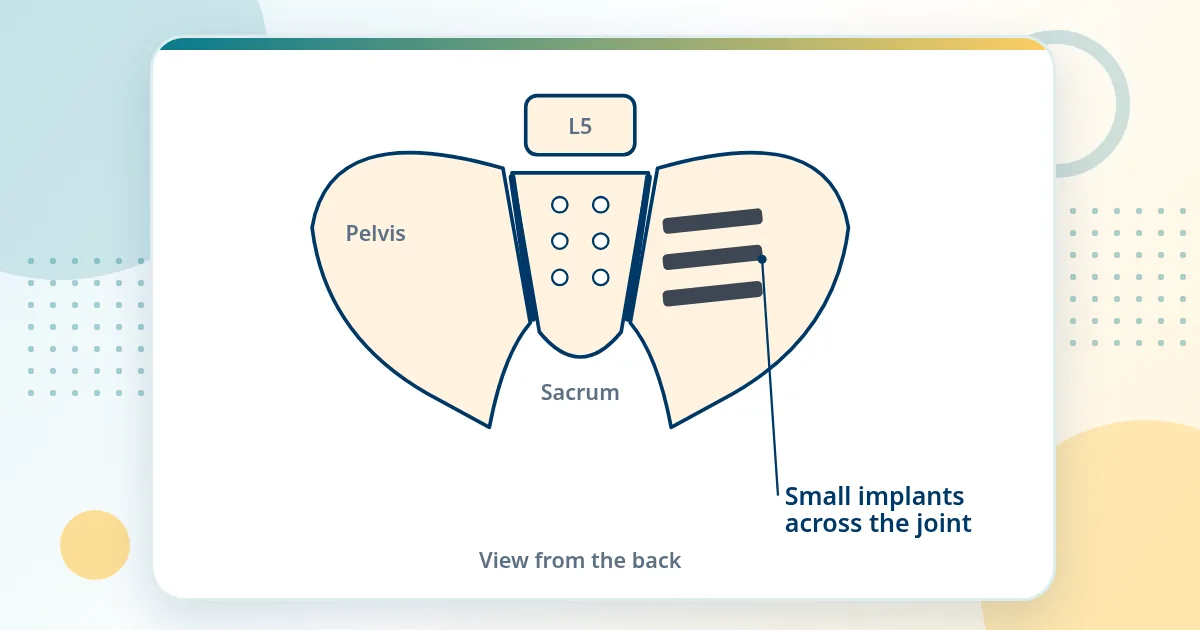
For confirmed SI joint pain that continues after about six months of care, SI Joint Fusion may be an option. GSMC uses the CornerLoc system with a posterolateral approach. Through a small incision and with live X-ray guidance, 2 to 3 titanium screws are placed from the back of the pelvis across the joint to hold it steady. No separate bone graft is taken from your body, and many people go home the same day.
Risks
Every procedure has risks, including infection, bleeding, soreness and, rarely, nerve irritation. For SI Joint Fusion there is also a chance that pain does not improve as much as hoped. Our team reviews your specific risks before any procedure.
Get urgent care right away for back pain with fever, loss of bladder or bowel control, numbness in the groin or new leg weakness.
SI joint care at GSMC
Our team evaluates SI joint pain at all 7 GSMC offices in Ocean and Monmouth County: Whiting, Toms River, Brick, Barnegat, Manahawkin, Freehold and West Long Branch. Patients from Eatontown and nearby towns are often closest to our West Long Branch office. Dr. Mann performs SI joint injections, radiofrequency ablation and CornerLoc SI Joint Fusion.
Request a consultation to talk with our team.
Frequently Asked Questions
What does SI joint pain feel like?
It is usually a dull or sharp ache on one side of the low back, just below the belt line, that can spread into the buttock, hip or groin. It often gets worse with standing up from a chair, climbing stairs or lying on the painful side.
How is SI joint pain diagnosed?
A hands-on exam with several provocation tests points to the joint. A diagnostic SI joint injection, done with X-ray guidance, confirms it: if the pain eases a lot for a few hours, the joint is the likely source.
Can SI joint pain go away on its own?
Many flares settle in weeks with activity changes, physical therapy and an SI belt. Pain that lasts longer than about three months is worth a full evaluation.
Is SI joint fusion a big operation?
No. GSMC uses the CornerLoc system, a minimally invasive procedure done through a small incision with live X-ray guidance. Two to three titanium screws are placed from the back across the joint, and no separate bone graft is taken from your body.
Who performs SI joint procedures at GSMC?
Dr. Dharam Mann performs SI joint injections, radiofrequency ablation and CornerLoc SI joint fusion.
Medical disclaimer: This article is for general education only and is not medical advice. Please talk with your own doctor about your symptoms and treatment. Individual results vary.