
Patient brochure (PDF) All procedures & brochures
Overview
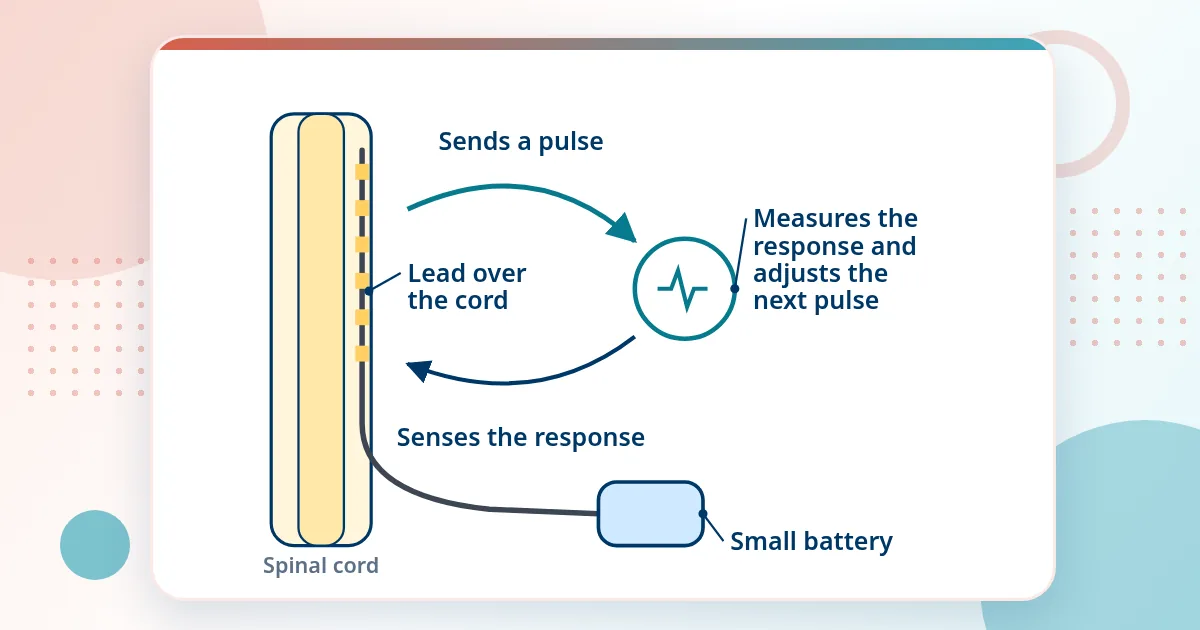
Spinal cord stimulation (SCS) sends mild electrical pulses to the spinal cord that may change how pain signals reach the brain. With traditional systems, the strength of the signal reaching the spinal cord can change when you move, cough or lie down. Closed-loop SCS is designed to keep stimulation steady as you move. The Evoke system, made by Saluda Medical and FDA-approved in 2022, measures how the spinal cord responds to each pulse and adjusts automatically many times per second. It may help some people with chronic trunk and limb pain that is hard to treat. As with other SCS, you try it first in a trial.
GSMC is led by Dr. Dharam Mann, who completed fellowships in pain management, cardiac anesthesia and critical care at Massachusetts General Hospital/Harvard.
Watch: how spinal cord stimulation works
Video: “How SCS Works” from MedtronicChronicPain on YouTube. It loads from youtube-nocookie.com only when you press play. Shown for general education; GSMC did not produce it. Watch on YouTube
What it is
When a stimulator sends a pulse, the nerve fibers in the spinal cord respond with a tiny electrical signal called an evoked compound action potential, or ECAP. The Evoke system measures this response after each pulse. If the response is too strong or too weak, for example because you changed position, the system adjusts the next pulse. This "closed loop" is designed to keep the dose of stimulation steady.
Studies compared it with traditional open-loop systems. In clinical studies, many patients reported meaningful pain relief at two years; results vary.
Who it's for
Closed-loop SCS may help some adults with:
- Chronic, hard-to-treat pain of the trunk and/or limbs, such as back and leg pain
- Ongoing pain after spine surgery (failed back surgery syndrome)
- Nerve pain in the legs that has not improved with other treatments
- People who noticed with a previous stimulator that the feeling changed a lot with movement or position (ask whether this may apply to you)
SCS is usually considered after other treatments have not given enough relief.
What the procedure involves, step by step
Step 1: Evaluation. We review your history, exam and imaging. Many insurance plans also ask for a psychological evaluation before a trial.
Step 2: The trial. 1. In an outpatient procedure, temporary leads are placed through a needle into the epidural space using live X-ray guidance. 2. The leads connect to a device worn outside the body, and the system is set up to read your spinal cord's responses. 3. For several days, often about a week, you go about your normal routine and track your pain, sleep and activity. 4. The temporary leads are removed in the office.
Step 3: The decision. You and your physician review how much your pain and function changed. If the trial did not help enough, nothing more is placed.
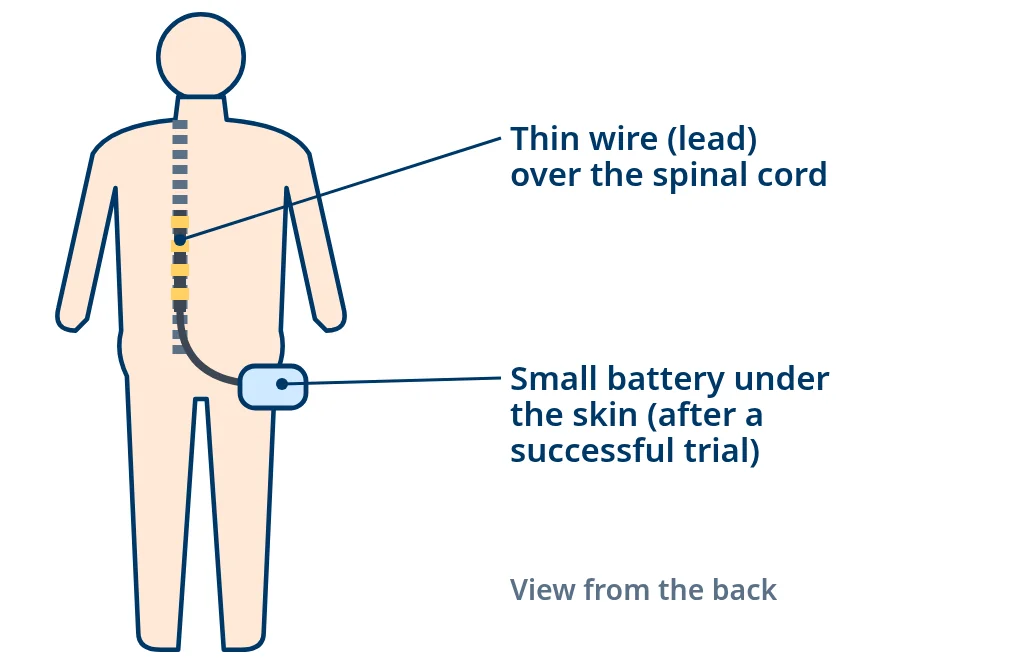
Step 4: The permanent implant. 1. A permanent system is placed in a separate outpatient procedure with sedation or anesthesia. 2. Leads are placed in the epidural space and connected to a small rechargeable generator under the skin. 3. Most people go home the same day. Your care team programs the system and shows you how to use and charge it.
Recovery and what to expect
- After the trial, avoid bending, twisting and lifting so the leads do not move.
- After the implant, soreness at the incisions is common for a week or two. You will usually limit bending, twisting, reaching overhead and heavy lifting for several weeks.
- The generator is rechargeable. Your care team will explain how often to charge it.
- Follow-up visits are used to adjust the settings.
- Some people notice less pain, and some do not.
Candidacy: who may or may not be a good fit
May be a good fit: adults with chronic, hard-to-treat trunk or limb pain who have tried other treatments, have realistic goals and have a good response during the trial.
May not be a good fit: people with an active infection, a bleeding problem or blood thinners that cannot be safely paused, untreated mental health conditions that need care first, a spine problem that needs surgery to fix, or who are unable to use and charge the device. Ask about MRI rules for this system before any scan.
Risks in brief
Risks are similar to other spinal cord stimulators: infection, bleeding, lead movement, pain at the generator site, device problems and the need for another procedure. A spinal fluid leak and headache are uncommon. Nerve injury is rare. We will review your specific risks.
Alternatives
Other options may include physical therapy, medicines, injections, radiofrequency ablation, other spinal cord stimulation systems, dorsal root ganglion stimulation, peripheral nerve stimulation or an implanted pain pump.
Frequently asked questions
What does closed-loop mean?
The system measures how your spinal cord responds to each pulse and adjusts the next pulse automatically. It is designed to keep stimulation steady as you move.
What is an ECAP?
An evoked compound action potential is the tiny electrical response of spinal cord nerve fibers to a stimulation pulse. The Evoke system measures it.
How is this different from other spinal cord stimulators?
Traditional open-loop systems deliver pulses at fixed settings. Closed-loop systems adjust in real time. Studies compared the two; results vary.
Is there a trial?
Yes. A temporary trial is done first so you can see whether it helps in daily life.
Will I feel the stimulation?
It depends on your settings. Some people feel a mild tingling, and others feel little.
Can the system be removed?
Yes. It can be turned off or removed if needed.
Insurance
GSMC participates with all Aetna plans, including Aetna HMO, and with many other insurance plans. Coverage for a specific procedure depends on your plan and may need prior authorization; call 732-202-3000 to verify. Our team can help check your benefits before treatment.
Where to get closed-loop spinal cord stimulation near you
GSMC has 7 offices in Ocean and Monmouth County, with one phone number for all of them. Call 732-202-3000 to confirm which office offers closed-loop spinal cord stimulation.
- Toms River1314 Hooper Ave, 1st Floor, Toms River, NJ 08753Get directions · 732-202-3000
- Brick1608 NJ-88, Suite 102, Brick Township, NJ 08724Get directions · 732-202-3000
- Whiting1100 NJ-70, Entrance B, Whiting, NJ 08759Get directions · 732-202-3000
- Barnegat249 S Main St, Suite 5, Barnegat Township, NJ 08005Get directions · 732-202-3000
- Manahawkin1109 Beacon Ave, Manahawkin, NJ 08050Get directions · 732-202-3000
- Freehold322 Professional View Dr, 300 Building, 2nd Floor, Freehold, NJ 07728Get directions · 732-202-3000
- West Long Branch100 NJ-36, Suite 1K, West Long Branch, NJ 07764Get directions · 732-202-3000
Patients come to us from Toms River, Brick, Lakewood, Jackson, Manchester, Whiting, Lacey, Barnegat, Manahawkin, Long Beach Island, Little Egg Harbor, Tuckerton, Freehold, Howell, Marlboro, Manalapan, Wall, West Long Branch, Long Branch, Eatontown, Red Bank, Neptune, Point Pleasant and other towns across Ocean and Monmouth County.
Nearby hospitals and imaging centers
Our offices are a short drive from these area hospitals and imaging centers:
- Community Medical Center (Toms River), near our Toms River office
- Ocean University Medical Center (Brick), near our Brick office
- Monmouth Medical Center Southern Campus (Lakewood), near our Brick office
- Southern Ocean Medical Center (Manahawkin), near our Manahawkin office
- CentraState Medical Center (Freehold), near our Freehold office
- Monmouth Medical Center (Long Branch), near our West Long Branch office
- Jersey Shore University Medical Center (Neptune), near our West Long Branch office
- Riverview Medical Center (Red Bank), near our West Long Branch office
- University Radiology (Toms River), near our Toms River office
- New Jersey Imaging Network - Toms River East (Toms River), near our Toms River office
- Atlantic Medical Imaging (Brick, Toms River, Manahawkin and Wall)
Listed for directions only.
Book an appointment
One phone number for all 7 GSMC offices in Ocean and Monmouth County.
Our offices
- Whiting
- Toms River (1314 Hooper Ave)
- Brick
- Barnegat
- Manahawkin
- Freehold (322 Professional View Dr)
- West Long Branch
Telehealth visits are available for second opinions and imaging reviews only, by phone. Please call 732-202-3000 to book one.
This page is general patient education and does not replace advice from your own clinician. Individual results vary, and no outcome can be promised.