
Overview
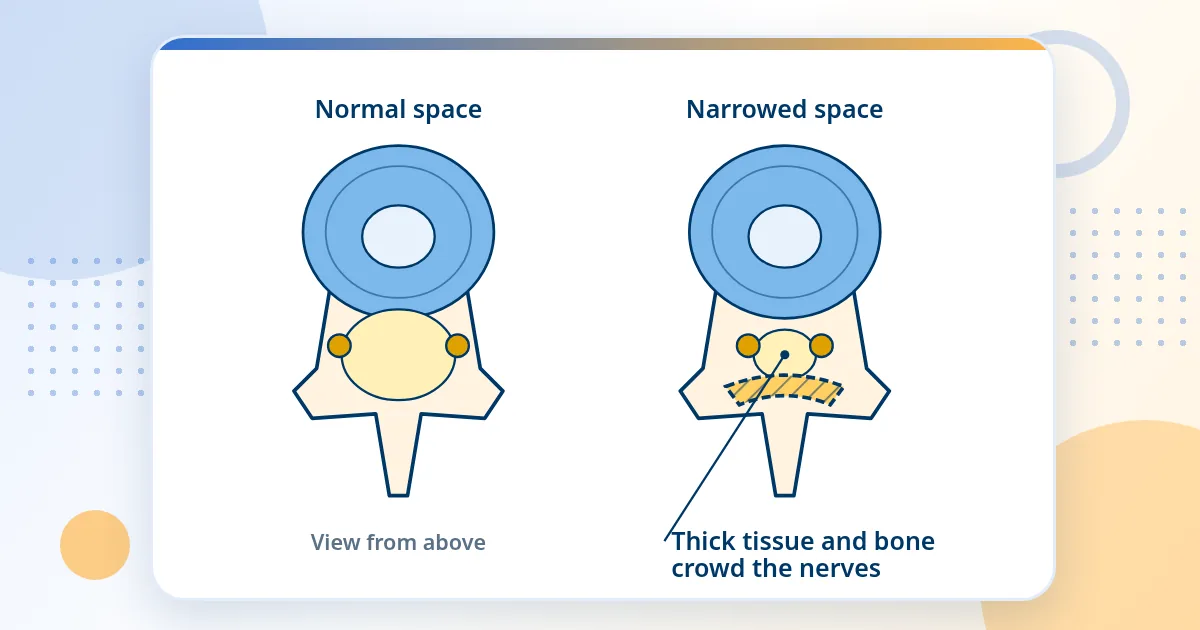
Spinal stenosis means the space around the nerves in your spine has become narrow. In the lower back, this can squeeze the nerves that go to your legs. Many people notice leg pain, heaviness or tingling when they stand or walk. The pain often eases when they sit down or lean forward. Spinal stenosis is common as people get older. The good news is that there are many ways to manage it, and most people start with simple steps. Our physicians can help find out what is causing your pain and which options may help you.
Watch: Spinal Stenosis explained
Video: “Spinal Stenosis” from OrthoInfo on YouTube. It loads from youtube-nocookie.com only when you press play. Shown for general education; GSMC did not produce it. Watch on YouTube
What it is
Your spine has a canal in the middle that holds the spinal cord and nerves. Over time, this canal can get smaller. Common reasons include:
- A ligament in the back of the spine (the ligamentum flavum) that gets thicker
- Arthritis in the small facet joints, sometimes with bone spurs
- A disc that bulges into the canal
- One bone slipping forward on another (spondylolisthesis)
When the narrowing presses on nerves, it can cause symptoms. Stenosis can also happen in the neck (cervical stenosis), but this page focuses on the lower back (lumbar stenosis).
Symptoms
Symptoms often build slowly. They may include:
- Pain, heaviness, cramping or tiredness in the legs or buttocks when you stand or walk
- Relief when you sit, bend forward or lean on something, like a shopping cart
- Numbness or tingling in the legs or feet
- Low back pain
- Being able to walk shorter distances than before
Some people have changes on an MRI but no symptoms at all. That is why your exam matters as much as your images.
Get urgent care (call 911 or go to the emergency room) if you have new or quickly worsening leg weakness, numbness in the groin or inner thighs, or loss of bladder or bowel control. These can be signs of a serious nerve problem.
How it is diagnosed, step by step
- Talk and history. We ask when the pain started, what makes it better or worse, how far you can walk and what you have tried.
- Physical exam. We check your strength, reflexes, feeling and how you walk.
- Imaging. An X-ray, MRI or CT scan may show where and why the canal is narrow.
- Other tests if needed. Nerve tests or a check of blood flow to the legs may help rule out other causes, since poor circulation can also cause leg pain with walking.
- A plan together. We match your options to your symptoms, imaging and goals.
Treatment and what to expect
Care is usually step by step. Many people start with the simplest options and move on only if pain continues.
- Self-care and activity: short walks, a stationary bike or water exercise. Leaning-forward positions often feel easier.
- Physical therapy: exercises for core strength, flexibility and walking.
- Medicines: your clinician may suggest certain medicines for a short time.
- Epidural steroid injection: may calm nerve irritation and ease leg pain for some people.
- Minimally invasive procedures: for selected people, the mild® procedure (to remove part of a thickened ligament) or an interspinous spacer may be options.
- Spinal cord stimulation: may be considered for some people with ongoing pain.
- Surgery: a decompression surgery (such as a laminectomy) may be discussed when symptoms are severe, getting worse or causing weakness.
Stenosis often changes slowly. Some people stay the same for years, some get better and some get worse. Regular follow-up helps us adjust your plan.
Who may be a good fit for treatment
You may benefit from an evaluation if leg or back pain limits how far you can walk or stand, or if you have tried rest and home exercise without enough relief.
Some treatments are not right for everyone. For example, people with an active infection, a bleeding problem or certain spine conditions may need a different plan. Our physicians will review your health history, medicines and imaging before suggesting any procedure.
Risks in brief
Spinal stenosis itself can sometimes get worse over time and, rarely, cause lasting weakness or numbness. Each treatment has its own risks. Injections and procedures can cause soreness, bleeding, infection or, rarely, nerve injury. Surgery has larger risks and a longer recovery. We will go over the risks of any option with you before you decide.
Alternatives
There is no single right treatment. Depending on your situation, options may include watching and waiting, physical therapy, medicines, injections, minimally invasive procedures, spinal cord stimulation or surgery. You can also ask for a second opinion.
Frequently asked questions
Why do my legs hurt when I walk but feel better when I sit?
Standing up straight makes the spinal canal a little narrower. Sitting or bending forward opens it slightly, which takes some pressure off the nerves.
Will spinal stenosis get worse?
Not always. For many people it changes slowly, and some stay about the same for years. Tell us if you notice new weakness or trouble walking.
Do I need surgery?
Many people manage stenosis without surgery. Therapy, injections and minimally invasive procedures may help some people. Surgery is usually considered when symptoms are severe or getting worse.
What is the difference between the mild® procedure and a spacer?
The mild® procedure removes small pieces of a thickened ligament and leaves no implant. An interspinous spacer is a small implant that holds space open between two bones in the back of the spine.
Can exercise help spinal stenosis?
For some people, yes. Physical therapy, cycling and water exercise may help you stay active. Ask us which exercises are safe for you.
How do I know if my leg pain is from my spine?
Leg pain can also come from poor blood flow, nerve damage or hip problems. An exam and the right tests help find the cause.
Insurance
GSMC participates with all Aetna plans, including Aetna HMO, and with many other insurance plans. Coverage for a specific procedure depends on your plan and may need prior authorization; call 732-202-3000 to verify. Our team can help check your benefits before treatment.
Where to get spinal stenosis care near you
GSMC has 7 offices in Ocean and Monmouth County, with one phone number for all of them. Call 732-202-3000 to confirm which office offers spinal stenosis care.
- Toms River1314 Hooper Ave, 1st Floor, Toms River, NJ 08753Get directions · 732-202-3000
- Brick1608 NJ-88, Suite 102, Brick Township, NJ 08724Get directions · 732-202-3000
- Whiting1100 NJ-70, Entrance B, Whiting, NJ 08759Get directions · 732-202-3000
- Barnegat249 S Main St, Suite 5, Barnegat Township, NJ 08005Get directions · 732-202-3000
- Manahawkin1109 Beacon Ave, Manahawkin, NJ 08050Get directions · 732-202-3000
- Freehold322 Professional View Dr, 300 Building, 2nd Floor, Freehold, NJ 07728Get directions · 732-202-3000
- West Long Branch100 NJ-36, Suite 1K, West Long Branch, NJ 07764Get directions · 732-202-3000
Patients come to us from Toms River, Brick, Lakewood, Jackson, Manchester, Whiting, Lacey, Barnegat, Manahawkin, Long Beach Island, Little Egg Harbor, Tuckerton, Freehold, Howell, Marlboro, Manalapan, Wall, West Long Branch, Long Branch, Eatontown, Red Bank, Neptune, Point Pleasant and other towns across Ocean and Monmouth County.
Nearby hospitals and imaging centers
Our offices are a short drive from these area hospitals and imaging centers:
- Community Medical Center (Toms River), near our Toms River office
- Ocean University Medical Center (Brick), near our Brick office
- Monmouth Medical Center Southern Campus (Lakewood), near our Brick office
- Southern Ocean Medical Center (Manahawkin), near our Manahawkin office
- CentraState Medical Center (Freehold), near our Freehold office
- Monmouth Medical Center (Long Branch), near our West Long Branch office
- Jersey Shore University Medical Center (Neptune), near our West Long Branch office
- Riverview Medical Center (Red Bank), near our West Long Branch office
- University Radiology (Toms River), near our Toms River office
- New Jersey Imaging Network - Toms River East (Toms River), near our Toms River office
- Atlantic Medical Imaging (Brick, Toms River, Manahawkin and Wall)
Listed for directions only.
Book an appointment
One phone number for all 7 GSMC offices in Ocean and Monmouth County.
Our offices
- Whiting
- Toms River (1314 Hooper Ave)
- Brick
- Barnegat
- Manahawkin
- Freehold (322 Professional View Dr)
- West Long Branch
Telehealth visits are available for second opinions and imaging reviews only, by phone. Please call 732-202-3000 to book one.
This page is general patient education and does not replace advice from your own clinician. Individual results vary, and no outcome can be promised.