
Overview
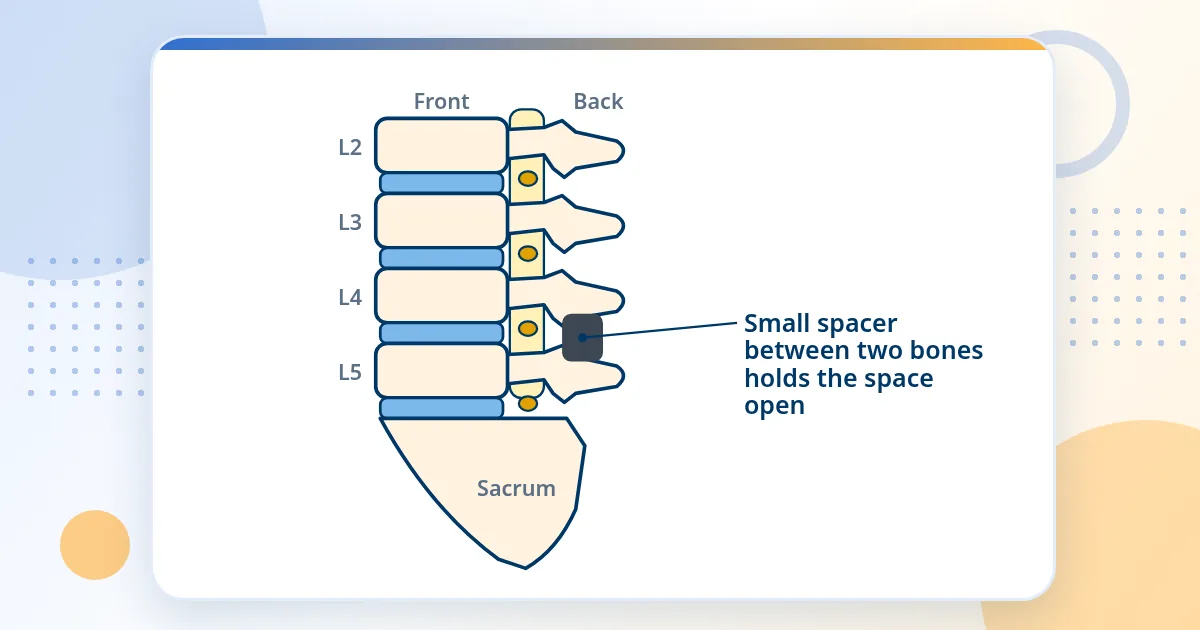
An interspinous spacer is a small implant for some people with lumbar spinal stenosis. Stenosis means the space around the nerves in the lower back is narrow, which can cause leg pain, heaviness or tingling when you stand or walk. Many people with stenosis feel better when they sit or bend forward, because that opens the space. A spacer is placed between two bony bumps on the back of the spine to help hold that space open. For some people, it may help them stand and walk longer with less leg pain.
Watch and learn
Video: “Vertiflex Superion Patient Animation” from Coastal Orthopedics - Bradenton, FL on YouTube. The animation was made by Vertiflex (now part of Boston Scientific), the maker of the Superion spacer; it was posted to YouTube by an orthopedic practice. It loads from youtube-nocookie.com only when you press play. Shown for general education; GSMC did not produce it. Watch on YouTube
Video: “Robert Lee finds spinal stenosis relief with Vertiflex procedure by Dr. Dharam Mann, MD” on YouTube, posted by TopDoc Marketing. A GSMC patient describes his own experience. Individual results vary. It loads from youtube-nocookie.com only when you press play. Watch on YouTube
What it is
The spinous processes are the bony bumps you can feel along the middle of your back. An interspinous spacer sits between two of them. It works a bit like a doorstop, keeping the space from closing down when you stand straight.
The Vertiflex procedure uses the Superion interspinous spacer, made by Boston Scientific. It is placed through a small incision and does not require removing bone or fusing the spine.
Who it's for
An interspinous spacer may help people who have:
- Moderate lumbar spinal stenosis at one or two levels
- Leg, buttock or groin pain, heaviness or tingling when standing or walking
- Relief when sitting or bending forward
- At least six months of nonsurgical care without enough relief
What the procedure involves, step by step
- Before: we review your MRI or CT, X-rays and health history, and plan which level or levels to treat.
- Anesthesia: the procedure is usually done as an outpatient with sedation or anesthesia.
- Small incision: a small cut is made in the middle of the lower back.
- Placement: using live X-ray guidance, your doctor places the spacer between the spinous processes and opens it to hold the space.
- Closing: the incision is closed and covered.
- Going home: most people go home the same day.
Procedures that are right for outpatient care may be done at GSMC's surgery center. Others are done in a hospital. Your doctor will explain where your procedure would take place.
Recovery and what to expect
- Most people walk the same day.
- For the first few weeks, you will usually limit bending, twisting and heavy lifting.
- Many people return to normal activities over about 2 to 6 weeks.
- Some people notice less leg pain soon after. For others it takes longer, and some people do not improve.
- Your doctor will give you a written plan and see you for follow-up visits.
Candidacy: who may or may not be a good fit
May be a good fit: people with moderate lumbar spinal stenosis whose leg symptoms improve when they sit or bend forward, and who have not improved enough with nonsurgical care.
May not be a good fit: people with severe stenosis, significant spine instability or a large slip of one bone on another, a fracture, severe osteoporosis, prior surgery at the same level, severe scoliosis, an active infection, or a nerve emergency such as loss of bladder or bowel control. Your exam, imaging and overall health decide whether this option fits you.
Risks in brief
Every surgery has risks. These include infection, bleeding, wound problems, the spacer moving, a fracture of the spinous process, ongoing or returning symptoms and the need for another surgery later. Anesthesia also carries risks. Your doctor will review these with you.
Alternatives
Other options may include physical therapy, medicines, epidural steroid injections, the mild® procedure, spinal cord stimulation or decompression surgery (such as a laminectomy). You can also ask for a second opinion.
Frequently asked questions
Is this the same as the mild® procedure?
No. The mild® procedure removes part of a thickened ligament and leaves no implant. A spacer is an implant that holds space open between two bones.
Can the spacer be removed?
It is designed to stay in place, but it can be removed if needed.
Will I feel the spacer?
Most people do not feel the spacer once they have healed.
Where is it done?
It is usually an outpatient procedure. Procedures that are right for outpatient care may be done at GSMC's surgery center; others are done in a hospital.
How long is recovery?
Most people walk the same day and return to normal activities over about 2 to 6 weeks, with limits on bending and lifting at first.
Does a spacer rule out other surgery later?
No. If symptoms continue or come back, other options, including decompression surgery, may still be possible.
Insurance
GSMC participates with all Aetna plans, including Aetna HMO, and with many other insurance plans. Coverage for a specific procedure depends on your plan and may need prior authorization; call 732-202-3000 to verify. Our team can help check your benefits before treatment.
Where to get interspinous spacer treatment near you
GSMC has 7 offices in Ocean and Monmouth County, with one phone number for all of them. Call 732-202-3000 to confirm which office offers interspinous spacer treatment.
- Toms River1314 Hooper Ave, 1st Floor, Toms River, NJ 08753Get directions · 732-202-3000
- Brick1608 NJ-88, Suite 102, Brick Township, NJ 08724Get directions · 732-202-3000
- Whiting1100 NJ-70, Entrance B, Whiting, NJ 08759Get directions · 732-202-3000
- Barnegat249 S Main St, Suite 5, Barnegat Township, NJ 08005Get directions · 732-202-3000
- Manahawkin1109 Beacon Ave, Manahawkin, NJ 08050Get directions · 732-202-3000
- Freehold322 Professional View Dr, 300 Building, 2nd Floor, Freehold, NJ 07728Get directions · 732-202-3000
- West Long Branch100 NJ-36, Suite 1K, West Long Branch, NJ 07764Get directions · 732-202-3000
Patients come to us from Toms River, Brick, Lakewood, Jackson, Manchester, Whiting, Lacey, Barnegat, Manahawkin, Long Beach Island, Little Egg Harbor, Tuckerton, Freehold, Howell, Marlboro, Manalapan, Wall, West Long Branch, Long Branch, Eatontown, Red Bank, Neptune, Point Pleasant and other towns across Ocean and Monmouth County.
Nearby hospitals and imaging centers
Our offices are a short drive from these area hospitals and imaging centers:
- Community Medical Center (Toms River), near our Toms River office
- Ocean University Medical Center (Brick), near our Brick office
- Monmouth Medical Center Southern Campus (Lakewood), near our Brick office
- Southern Ocean Medical Center (Manahawkin), near our Manahawkin office
- CentraState Medical Center (Freehold), near our Freehold office
- Monmouth Medical Center (Long Branch), near our West Long Branch office
- Jersey Shore University Medical Center (Neptune), near our West Long Branch office
- Riverview Medical Center (Red Bank), near our West Long Branch office
- University Radiology (Toms River), near our Toms River office
- New Jersey Imaging Network - Toms River East (Toms River), near our Toms River office
- Atlantic Medical Imaging (Brick, Toms River, Manahawkin and Wall)
Listed for directions only.
Book an appointment
One phone number for all 7 GSMC offices in Ocean and Monmouth County.
Our offices
- Whiting
- Toms River (1314 Hooper Ave)
- Brick
- Barnegat
- Manahawkin
- Freehold (322 Professional View Dr)
- West Long Branch
Telehealth visits are available for second opinions and imaging reviews only, by phone. Please call 732-202-3000 to book one.
This page is general patient education and does not replace advice from your own clinician. Individual results vary, and no outcome can be promised.