

Wrist Arthritis Pain: Understanding Arterial Embolization
Nov 6, 2026
By the Garden State Medical Center team
Opening a jar, turning a key, or lifting a coffee mug can become uncomfortable when wrist osteoarthritis affects your grip. If a brace, therapy, medicines, or injections have not helped enough, you may wonder what other approaches are being studied.
Arterial embolization is one of those approaches. Also called transarterial embolization (TAE) or transarterial musculoskeletal embolization (TAME), it targets abnormal blood vessels associated with inflammation. For wrist osteoarthritis, it remains an emerging treatment, not an established solution for every painful wrist.
What is wrist osteoarthritis?
Osteoarthritis involves changes in cartilage, the smooth tissue covering the ends of bones, along with changes in bone and the joint lining. In the wrist, it can develop after a previous fracture or ligament injury, as well as through other degenerative changes.
Symptoms may include aching, stiffness, swelling, reduced motion, and pain with gripping or bearing weight through the hand. Learn more in our osteoarthritis overview.
Not every sore wrist has osteoarthritis. Tendon problems, nerve compression, rheumatoid arthritis, and injuries can cause similar symptoms. A diagnosis matters because treatments address different sources of pain.
Why target blood vessels to treat joint pain?
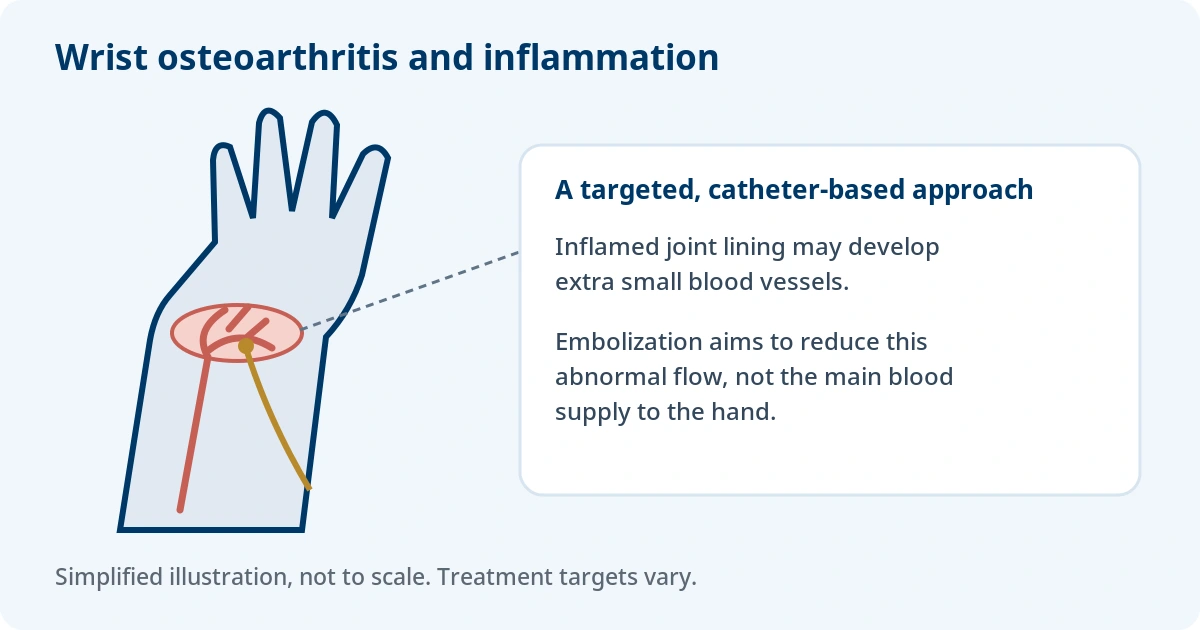
Osteoarthritis is more than a cartilage problem. The synovium, or lining of the joint, may become inflamed. This inflammation can be associated with growth of small, abnormal blood vessels, called neovessels. Pain-sensing nerve fibers may develop alongside them.
These changes are thought to contribute to ongoing pain in some arthritic joints. Embolization aims to reduce this abnormal blood flow in inflamed tissue, including the synovium, while preserving circulation to healthy structures. It does not shut off the main blood supply to the hand.
What does the research tell us?
Embolization has been studied more extensively for knee osteoarthritis than for the wrist or hand. Even knee research has mixed results, so findings should not be assumed to apply to the wrist.
A small 2024 study in Diagnostic and Interventional Radiology, “Short-term clinical outcomes of transarterial embolization for symptomatic hand osteoarthritis refractory to conservative treatment,” reported pain improvement. However, it lacked a comparison group and was not a large trial dedicated to wrist osteoarthritis.
Research on chronic wrist pain also includes conditions other than arthritis. Improvements in tendon-related wrist pain do not establish that the same treatment works for wrist osteoarthritis. Larger controlled studies are needed to clarify who benefits, how long relief lasts, and the risks.
What typically happens during embolization?
Techniques and embolic materials vary across published studies. The following describes a general catheter-based approach. Your interventional radiologist adapts the access site, technique and materials to your evaluation and treatment plan.
- Consultation and imaging. The physician reviews your symptoms, previous treatments, and goals, examines the wrist, and reviews X-rays. Ultrasound or MRI may help assess inflammation or another problem. Hand circulation, kidney function, allergies, and medicines also need review.
- Preparation and artery access. Local anesthetic numbs the entry area. Sedation may be used. The physician chooses an artery access site based on your anatomy and treatment plan, then introduces a thin catheter through a small skin opening.
- Finding the target. Live X-ray imaging and contrast dye help map the blood vessels. A smaller catheter can be guided toward branches supplying the painful wrist region. The physician looks for abnormal blood flow corresponding to your symptoms.
- Treating the abnormal vessels. Carefully delivered embolic material, often tiny particles, reduces flow to the targeted neovessels. Protecting normal circulation is particularly important in the hand and wrist.
- Monitoring afterward. The catheter is removed, and pressure or a closure device controls bleeding. These procedures are generally outpatient, with discharge after observation when appropriate. Arrange transportation if instructed, particularly when sedation is used.
Who might be considered?
An evaluation may be reasonable when confirmed wrist osteoarthritis continues to interfere with sleep, work, or daily tasks despite appropriate conservative care. That care may include activity changes, splinting, hand therapy, medicines, or injections.
There is no universally established wrist-embolization candidacy checklist. The physician must consider whether inflammation appears to contribute to your symptoms and whether the blood vessels can be treated safely.
Infection, poor hand circulation, significant kidney disease, contrast allergy, or a bleeding disorder may make treatment unsuitable or require additional precautions. Pain caused mainly by instability, nerve compression, or advanced structural damage may need a different approach. Wanting to avoid surgery does not, by itself, establish candidacy.
What embolization can and cannot do
The intended benefit is less pain and inflammation, potentially making daily use and therapy more comfortable. Relief is not guaranteed, and symptoms may return.
Embolization does not regrow cartilage, reverse osteoarthritis, repair a torn ligament, or replace a joint. It differs from wrist fusion or joint replacement because it treats blood vessels rather than surgically altering joint structures. Surgery may remain appropriate for selected patients with substantial damage or instability. A hand surgeon can explain those options without assuming that one approach fits everyone.
Risks and recovery
Possible side effects include a temporary pain flare, skin color changes, and bruising or bleeding where the artery was entered. Other risks include artery injury, infection, contrast reactions, and kidney problems related to contrast.
Unintended treatment of normal vessels, called nontarget embolization, can damage skin, nerves, or other tissues. Serious injury is a concern even when uncommon, and small wrist studies cannot precisely establish its frequency.
Recovery instructions depend on the access site and technique. Follow your team's guidance about dressings, lifting, work, driving, and returning to hand exercises. Do not stop blood thinners or other medicines on your own. Follow-up should assess both pain and useful function, not simply whether the procedure was completed.
After any arterial procedure, a cold, pale, numb, or increasingly painful hand, uncontrolled bleeding, or blistered or darkening skin needs urgent medical attention.
Where does it fit in your care?
Embolization would not replace a broader arthritis plan. Joint protection, a properly fitted splint, adapted tools, and therapist-guided movement may still help. Medicines and injections should be individualized to your health and diagnosis.
Talk with a physician if wrist pain persists or limits your grip. Seek prompt assessment for a hot, swollen joint with fever or sudden severe symptoms after injury.
Talk with the GSMC team
Garden State Medical Center serves Ocean and Monmouth County. Our interventional radiology service features Douglas Gibbens, MD, board certified in Interventional Radiology and Nuclear Medicine.
Patients can ask about an IR evaluation and candidacy for wrist embolization. Read our patient guide or download the printable PDF before your visit. Evidence for wrist osteoarthritis is more limited than for the knee, and insurance coverage varies. Our team will discuss the research, alternatives, risks and costs before you decide.
Call 732-202-3000 or request a consultation to discuss your wrist pain and next steps.
This article is for general education, not individualized medical advice. Results vary.