
Facet Joint Pain and Medial Branch Blocks
Oct 18, 2026
By the GSMC pain management team
Back or neck pain that is worse when you lean back, twist or stand for a long time, and better when you bend forward, often comes from the facet joints. These small joints link the vertebrae along the back of your spine. A medial branch block is a quick test that shows whether they are the true source of your pain, and it helps decide what comes next.
GSMC is led by Dr. Dharam Mann, who completed fellowships in pain management, cardiac anesthesia and critical care at Massachusetts General Hospital/Harvard.
This is Day 8 of our spine and sciatica series. Day 7 covered sacroiliac joint pain.
What is facet joint pain?
Each spine level has a pair of facet joints. Like other joints, they have cartilage and a lining that can wear down or become inflamed with age, arthritis or injury. When that happens, they can cause a deep ache in the low back or neck. Read more on our facet syndrome page.
Common signs
- An ache on one or both sides of the spine, often worse in the morning or after rest.
- Pain with leaning back, twisting or looking up.
- Low back pain that spreads to the buttock or upper thigh, but usually not below the knee.
- Neck pain that spreads to the shoulders or causes headaches at the base of the skull.
Imaging often shows facet arthritis, but many people with arthritis on an MRI have no pain at all. That is why a test block matters.
What is a medial branch block?
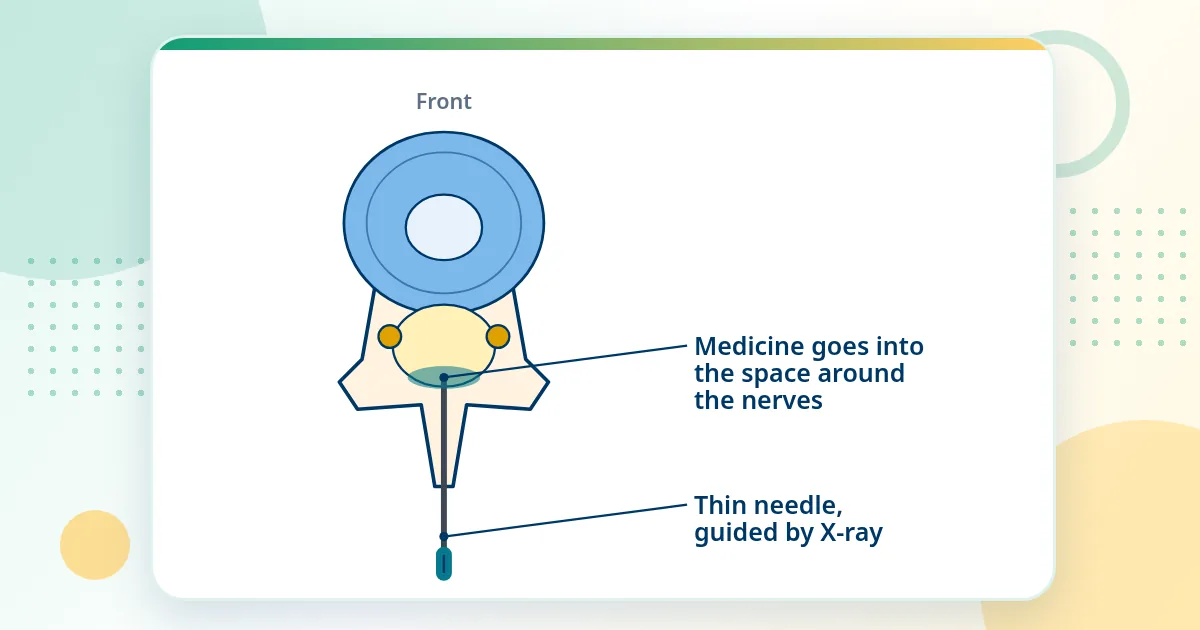
The medial branch nerves are tiny nerves that carry pain signals from each facet joint. In a medial branch block, a small amount of numbing medicine is placed next to these nerves using live X-ray guidance. If your usual pain drops a lot for several hours, the facet joints are very likely the source.
What to expect, step by step
- Before: we review your medicines and allergies. Blood thinners are paused only with approval from the doctor who prescribes them.
- During: you lie on your stomach, the skin is cleaned and numbed, and a thin needle is guided to each target with X-ray.
- Right after: you move the way that usually hurts and rate your pain. Please bring someone to drive you home.
- The next few hours: keep a simple pain diary, writing down your pain score every hour or two. This diary is the key result of the test.
Many plans ask for two separate blocks with clear relief before the next step, so a second test visit is common.
What the results mean
- Clear relief: you may be a candidate for radiofrequency ablation, which uses heat to quiet the same nerves for months or longer. Day 5 explains what to expect from RFA.
- Little or no relief: the pain likely comes from another source, such as a herniated disc, a pinched nerve or the SI joint, and our team will look at other options.
Risks
Medial branch blocks are low-risk. Possible side effects include soreness at the needle site, a short-lived increase in pain, bleeding, infection and, rarely, nerve irritation. Our team reviews your specific risks first.
Get urgent care right away for back pain with fever, loss of bladder or bowel control, numbness in the groin or new leg weakness.
Other options our team may discuss
- Physical therapy to strengthen the core and improve posture.
- A facet joint injection with steroid during a flare.
- Epidural steroid injections when a pinched nerve adds leg pain.
Facet joint care at GSMC
Our team evaluates facet joint pain at all 7 GSMC offices in Ocean and Monmouth County: Whiting, Toms River, Brick, Barnegat, Manahawkin, Freehold and West Long Branch. Patients from Matawan and nearby towns are often closest to our Freehold office. Dr. Mann performs medial branch blocks, facet joint injections and radiofrequency ablation.
Request a consultation to talk with our team.
Frequently Asked Questions
What is a medial branch block?
It is a test injection. A small amount of numbing medicine is placed next to the medial branch nerves, the tiny nerves that carry pain signals from the facet joints. If your usual back or neck pain eases for several hours, the facet joints are likely the source.
Does a medial branch block hurt?
The skin is numbed first, and most people feel pressure and brief discomfort. The visit usually takes less than an hour, including time to check your response.
What happens if the block works?
If you get clear relief, often from two separate blocks, you may be a candidate for radiofrequency ablation, which can quiet those same nerves for months or longer.
What if the block does not help?
That is useful information too. It suggests the pain is coming from somewhere else, such as a disc, a nerve root or the SI joint, and our team will look at other causes.
How is this different from a facet joint injection?
A facet joint injection places medicine inside the joint, often with a steroid to calm inflammation. A medial branch block numbs the nerves that serve the joint, mainly as a test before radiofrequency ablation.
Medical disclaimer: This article is for general education only and is not medical advice. Please talk with your own doctor about your symptoms and treatment. Individual results vary.