
Printable patient guide PDF: Print at home/office (Letter) · PDF: Print shop (with bleed)
Overview
Wrist osteoarthritis involves cartilage, bone and joint-lining changes. A prior fracture or ligament injury can contribute. Pain, stiffness and swelling may interfere with gripping or bearing weight through the hand.
Wrist arterial embolization aims to reduce abnormal blood flow associated with inflammation in selected patients. It is an emerging treatment, not an established solution for every painful wrist. Our team evaluates the diagnosis and discusses the limits of current evidence before you decide.
Why target blood vessels?
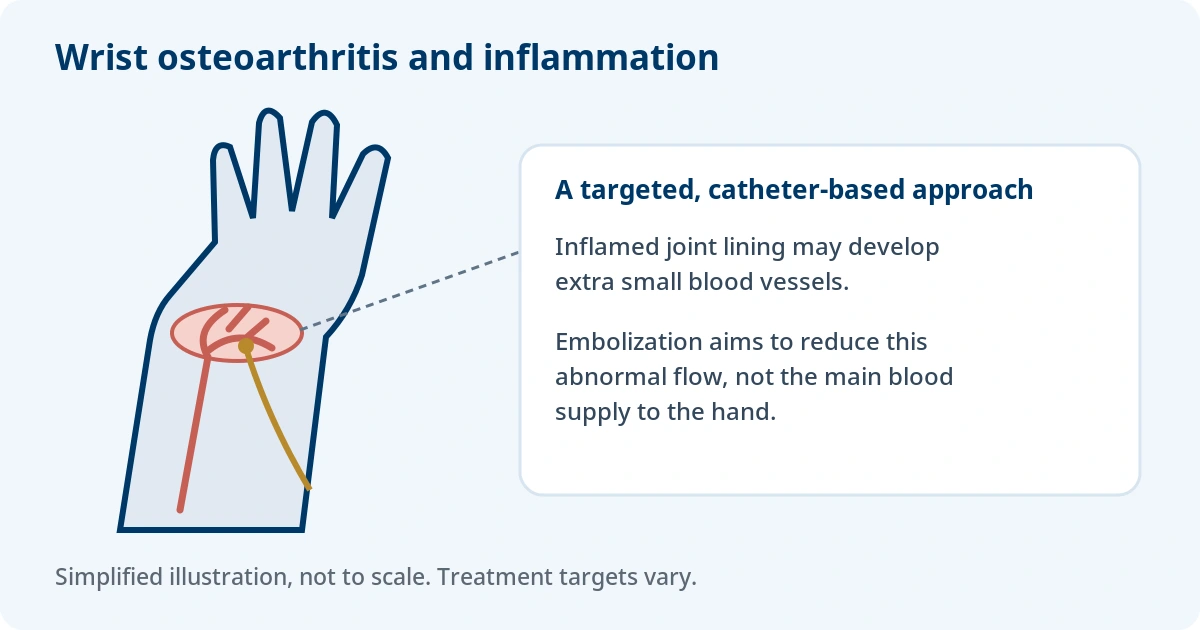
The synovium, or lining of the joint, may become inflamed and develop extra small vessels called neovessels. Pain-sensing nerve fibers may accompany them. Embolization seeks to reduce this abnormal flow while preserving circulation to healthy structures. It is not intended to shut off the main blood supply to the hand.
Who may be considered
- Confirmed wrist osteoarthritis with pain that limits daily tasks, sleep or work despite appropriate conservative care
- Persistent symptoms after options such as activity changes, splinting, hand therapy, medicines or injections
- An evaluation suggesting inflammation may contribute to pain and that the vessels can be treated safely
There is no universally established wrist-embolization candidacy checklist. An individualized review is essential.
Who may not be a good fit
- Infection in or near the wrist or poor hand circulation
- Pain mainly caused by nerve compression, instability or a condition other than osteoarthritis
- Advanced structural damage that may need a hand-surgery evaluation
- Significant kidney disease, contrast allergy or a bleeding disorder that makes the procedure unsuitable or requires precautions
- Pregnancy or other health concerns requiring individualized assessment
Your evaluation at any GSMC office
GSMC providers complete the evaluation and workup at any of our 7 offices. Bring prior imaging, your medication list and information about earlier treatment. We review your history, examine the wrist and hand circulation, and assess X-rays. Ultrasound or MRI and kidney-function testing may be requested. We also review blood thinners, allergies, alternatives, risks and coverage.
Procedure day: a general overview
The procedure is generally outpatient, at Manchester Surgery Center (1100 Route 70 West, Whiting) or Bey Lea Surgery Center (54 Bey Lea Road, Building 2, Toms River), by an interventional radiologist who works with the GSMC team. These are general catheter-based steps, not a fixed technique or duration for every wrist.
- Follow your individualized eating and medication instructions. Arrange a driver when instructed, especially if sedation is used.
- The team reviews your health, medicines and allergies. Local anesthetic numbs the chosen artery entry site; sedation may be used.
- An interventional radiologist guides a thin catheter using live X-ray and contrast to map vessels near the wrist. The access site depends on your anatomy and treatment plan.
- Embolic material is carefully delivered to selected abnormal branches while protecting normal circulation. Techniques and materials vary.
- The catheter is removed and pressure or a closure device controls bleeding. After observation, you go home when medically appropriate with written instructions.
Recovery and follow-up
Recovery depends on the access site, technique and your health. Follow your team’s instructions about dressings, bathing, lifting, driving, work and hand exercises. Do not stop blood thinners or other medicines on your own. Follow-up checks pain, useful hand function and the access site. Relief is not guaranteed and may not be lasting. There is no well-established wrist-specific recovery or pain-relief timetable.
Risks and warning signs
- Bruising, bleeding, a growing lump or artery injury where the catheter enters
- Temporary pain flare, skin tenderness or skin color changes
- Nontarget embolization: material reaching normal vessels can injure skin, nerves or other tissues
- Contrast allergy or kidney problems related to contrast
- Infection
- No meaningful pain relief, or pain returning later
Small wrist studies cannot precisely establish how often serious complications occur. Your physician will explain your individual risks.
Seek urgent medical attention for a cold, pale, numb or increasingly painful hand, uncontrolled bleeding, a growing access-site lump, or darkening, blistered or open skin. Call our team for fever or increasing redness. Call 911 for chest pain, trouble breathing or severe uncontrolled bleeding.
What it can do and how it compares
Joint protection, adapted tools, splinting, hand therapy and appropriate medicines are usual starting points. Injections may be considered for selected patients. Embolization targets abnormal vessels associated with inflammation; it does not regrow cartilage, reverse arthritis, repair ligament damage or replace a joint. Wrist fusion, joint replacement or another operation may be appropriate for substantial damage or instability. A hand surgeon can explain the trade-offs. Embolization does not remove the need for a broader arthritis care plan.
What the research shows
Embolization has been studied more extensively for knee osteoarthritis than for the wrist or hand. Knee findings are mixed and cannot establish effectiveness for the wrist. A small 2024 study in Diagnostic and Interventional Radiology reported pain improvement after embolization for symptomatic hand osteoarthritis, but had no comparison group and was not a large dedicated wrist-osteoarthritis trial. Larger controlled studies are needed to clarify benefit, duration and risks. Research on tendon-related wrist pain does not prove effectiveness for wrist osteoarthritis.
Source: Short-term clinical outcomes of transarterial embolization for symptomatic hand osteoarthritis refractory to conservative treatment. Diagnostic and Interventional Radiology. 2024;30:65-71. DOI: 10.4274/dir.2023.232350.
Insurance and cost
Coverage for wrist embolization varies. Insurers may consider joint embolization, including treatment of the wrist, investigational and may not cover it. Our team checks benefits and prior-authorization requirements and discusses costs before scheduling. If it is not covered, ask for a written self-pay estimate and information about covered alternatives.
Call 732-202-3000 to discuss benefits.
Frequently asked questions
Is this a cure for wrist osteoarthritis?
No. The aim is pain control, not cartilage regrowth or reversal of arthritis. Results vary.
Is it right for every painful wrist?
No. A diagnosis and review of hand circulation, imaging and prior treatment are essential. Wanting to avoid surgery alone does not establish candidacy.
How soon will it work and how long does relief last?
The evidence cannot establish a reliable wrist-specific timetable or duration. Some patients may not improve. Your physician will discuss realistic goals and follow-up.
Is it surgery?
It is an image-guided arterial procedure through a small skin opening, rather than an operation inside the joint. It still has risks, including tissue injury from unintended embolization.
Where do evaluation and treatment happen?
Evaluation and follow-up are available at any of our 7 GSMC offices. The outpatient procedure is performed by an interventional radiologist who works with the GSMC team at Manchester Surgery Center in Whiting or Bey Lea Surgery Center in Toms River.
Does insurance cover it?
Coverage for wrist embolization varies. Insurers may consider joint embolization, including treatment of the wrist, investigational and may not cover it. Our team checks benefits and prior-authorization requirements and discusses costs before scheduling. If it is not covered, ask for a written self-pay estimate and information about covered alternatives.
Who performs the procedure
Douglas Gibbens, MD, board certified in Interventional Radiology and Nuclear Medicine, performs interventional radiology procedures with the GSMC team. GSMC providers coordinate evaluation and follow-up at all 7 offices.
Where to schedule a consultation
Consultations are available at all 7 GSMC offices. Procedures are performed at Manchester Surgery Center (1100 Route 70 West, Whiting) or Bey Lea Surgery Center (54 Bey Lea Road, Building 2, Toms River).
- Whiting1100 NJ-70, Entrance B, Whiting, NJ 08759732-202-3000
- Toms River1314 Hooper Ave, 1st Floor, Toms River, NJ 08753732-202-3000
- Brick1608 NJ-88, Suite 102, Brick Township, NJ 08724732-202-3000
- Barnegat249 S Main St, Suite 5, Barnegat Township, NJ 08005732-202-3000
- Manahawkin1109 Beacon Ave, Manahawkin, NJ 08050732-202-3000
- Freehold322 Professional View Dr, 300 Building, 2nd Floor, Freehold, NJ 07728732-202-3000
- West Long Branch100 NJ-36, Suite 1K, West Long Branch, NJ 07764732-202-3000
Request a consultation
Bring a list of your medicines and any recent X-rays or MRI reports.
This page is general patient education and does not replace advice from your own clinician. Individual results vary, and no outcome can be promised. Insurance coverage varies.