
Overview
Sacral neuromodulation (also called sacral nerve stimulation, or SNM) is a therapy for bladder and bowel control. GSMC offers systems from two manufacturers: InterStim™ (Medtronic) and Axonics™ (Boston Scientific). The sacral nerves, in the lowest part of the spine, carry signals between the brain and the bladder, bowel and pelvic floor. When those signals are out of sync, the result can be sudden urges, leaking, trouble emptying the bladder or bowel leakage. A small system sends mild electrical pulses to these nerves to help restore more normal communication.
GSMC is led by Dr. Dharam Mann, who completed fellowships in pain management, cardiac anesthesia and critical care at Massachusetts General Hospital/Harvard.
At Garden State Medical Center, GSMC providers evaluate patients for this therapy and perform the minimally invasive implant procedure. Because you test it first, you and your physician can see how your symptoms respond before deciding on a long-term device. Both the evaluation and the long-term implant are performed by our physicians at Manchester Surgery Center, an outpatient ambulatory surgery center in Whiting.
Who it may help
Sacral neuromodulation may be an option for adults with:
- Overactive bladder and urge incontinence: strong, sudden urges, going very often, or leaking before you reach the bathroom
- Non-obstructive urinary retention: trouble emptying the bladder when nothing is physically blocking it
- Fecal (bowel) incontinence: accidental leakage of stool or gas
It is usually considered when diet and fluid changes, bladder training, pelvic floor therapy or medicines have not helped enough or caused side effects. Your history, exam and tests help decide whether it fits you. Some people are referred by their urologist, urogynecologist, colorectal specialist or primary care physician.
How it works
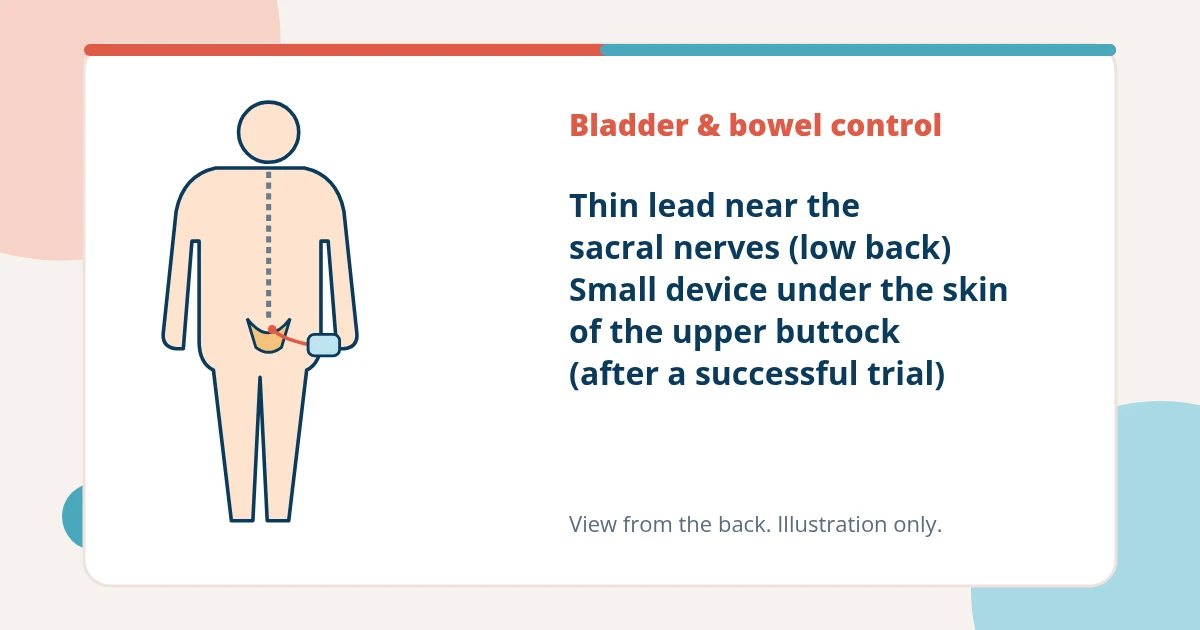
A thin, flexible wire called a lead is placed through a small opening in the low back so its tip rests near the S3 sacral nerve. During the evaluation it connects to a small external device. For long-term therapy, the lead connects to a small neurostimulator placed under the skin of the upper buttock. Most people feel a mild tingling or pulling in the pelvic area, or nothing at all. The settings are adjusted with a handheld patient programmer or remote control, depending on the system.
The two-step process
Step 1: Evaluation (trial). This is done at Manchester Surgery Center (1100 Route 70 West, Whiting, NJ 08759), an outpatient ambulatory surgery center. After a review of your symptoms and a bladder or bowel diary, a lead is placed near the sacral nerve. Depending on your situation this is either a test with a temporary wire or a longer test with a lead that can stay in place if you continue. You wear a small external stimulator for several days up to about two weeks and keep a diary of your symptoms, then we compare it with your starting diary.
Step 2: Long-term implant. If your symptoms improve meaningfully, a small neurostimulator is implanted at Manchester Surgery Center under the skin of the upper buttock in a minimally invasive outpatient procedure performed by our physicians, usually with local anesthesia and light sedation. Most people go home the same day. If the evaluation does not help enough, the test lead is removed and nothing more is placed.
Device options: InterStim™ and Axonics™
GSMC offers sacral neuromodulation systems from two manufacturers. Each has a rechargeable and a recharge-free model. The trial process is the same for both. The figures below are as stated by each manufacturer (October 2026). Actual battery life depends on your settings.
| System | Type | Charging | Battery life (manufacturer-stated) | MRI labeling |
|---|---|---|---|---|
| InterStim X™ (Medtronic) | Recharge-free | None | Over 10 years at expected settings; up to 15 years at low settings | MR-conditional: 1.5T and 3T full-body scans under specific conditions (with SureScan™ MRI leads) |
| InterStim™ Micro (Medtronic) | Rechargeable | About 20 minutes weekly | About 15 years at standard settings | |
| Axonics F15™ (Boston Scientific) | Recharge-free | None | About 17.6 years at 1 mA; longer at lower settings | MR-conditional: 1.5T and 3T full-body scans under specific conditions |
| Axonics R20™ (Boston Scientific) | Rechargeable | About every 6 to 10 months, wirelessly | Designed for 20+ years |
Rechargeable or recharge-free? Rechargeable devices are smaller but need regular charging. Recharge-free devices need no charging but are larger and will eventually need a replacement procedure. Your physician will help you weigh these trade-offs. MRI conditions differ between systems, so always confirm with us before any scan.
Sources: Medtronic InterStim™ patient and MRI information; Boston Scientific Axonics™ technical specifications.
What to expect
- Before: a visit to review your history, medicines (including blood thinners) and prior treatments, plus a 3-day symptom diary.
- Day of the procedure: numbing medicine and X-ray guidance are used to place the lead. Plan for someone to drive you home.
- Programming: our team sets up your device and teaches you to use the programmer before you leave.
- Follow-up: visits to check healing and fine-tune settings, and ongoing diaries to track progress.
Recovery
- Soreness at the small incisions is common for several days.
- Keep dressings clean and dry as instructed.
- Avoid heavy lifting, bending and strenuous activity for several weeks so the lead can settle. Most people return to light daily activities within a few days.
- Depending on the device you choose, it may need regular recharging or may be recharge-free (see device options above). Battery replacement may eventually be needed, which is a shorter outpatient procedure.
Your physician will give you written instructions that may differ from these general guidelines. Our sacral neuromodulation patient guide covers diaries, the trial week, incision care and using the programmer.
MRI and other medical care
Current InterStim™ and Axonics™ systems are labeled MR-conditional for 1.5T and 3T full-body scans. That means many patients can have MRI scans when specific conditions are followed. Always tell any imaging center or doctor that you have a sacral neuromodulation device, carry your device ID card, and call us before a scheduled MRI so we can confirm what applies to your system. Some devices may need to be turned off for certain procedures.
Risks in brief
Every procedure has risks. These include pain or discomfort at the device or lead site, lead movement, infection, unwanted stimulation or changes in bladder or bowel function, device problems and the need for another procedure. Your physician will review the risks and benefits with you.
Alternatives
Other options may include fluid and diet changes, bladder training, pelvic floor physical therapy, medicines, tibial neuromodulation, bladder Botox injections performed by a urologist, or other approaches recommended by your specialist.
Frequently asked questions
What are InterStim™ and Axonics™?
They are two brands of sacral neuromodulation system: InterStim™ is made by Medtronic, and Axonics™ is made by Axonics, now part of Boston Scientific. GSMC offers both. In each, a thin lead placed near the sacral nerves in the low back sends mild electrical pulses that help the brain and the bladder or bowel communicate more normally.
Can I try it before getting the implant?
Yes. Every patient starts with an evaluation (trial) period of several days up to about two weeks. You keep a symptom diary, and we review the results together before deciding on a long-term device.
Does it hurt?
Most people feel a mild tingling or pulling in the pelvic area, if they feel anything. The settings can be adjusted if the feeling is uncomfortable.
Can I have an MRI?
Current InterStim™ and Axonics™ systems are labeled MR-conditional for 1.5T and 3T full-body scans, which means many people can have MRI scans when specific conditions are met. The conditions differ by device. Always tell the imaging center about your device and bring your ID card. We will confirm what applies to your system.
Is it reversible?
Yes. The device can be turned off, adjusted or removed.
Is the battery rechargeable?
Both manufacturers offer a rechargeable model and a recharge-free model. Rechargeable devices are smaller but need regular charging; recharge-free devices need no charging but are larger and eventually need replacement. We review the options with you before the implant.
Which device will I get?
You and your physician choose together after a successful evaluation, based on your needs, how you feel about recharging, and your MRI and insurance considerations.
Will insurance cover it?
Many plans, including Medicare, cover sacral neuromodulation when medical criteria are met, often with prior authorization. Coverage varies, so please call us and we will verify your benefits.
Who performs sacral neuromodulation at GSMC, and where?
GSMC providers perform both the evaluation (trial) and the long-term implant at Manchester Surgery Center, an outpatient ambulatory surgery center at 1100 Route 70 West in Whiting. Consultations are available at all 7 GSMC offices.
Insurance
Many health plans, including Medicare, cover sacral neuromodulation when medical criteria are met. Coverage varies by plan and prior authorization is often required, so please call 732-202-3000 and our team will verify your benefits. See accepted insurance.
Our physicians
Both physicians evaluate patients and perform the evaluation and implant procedures at Manchester Surgery Center.
Where to schedule a consultation
Consultations are available at all 7 GSMC offices. Procedures are performed at Manchester Surgery Center, 1100 Route 70 West, Whiting, NJ 08759. Call 732-202-3000 to schedule at the office that is most convenient for you.
- Whiting1100 NJ-70, Entrance B, Whiting, NJ 08759Get directions · 732-202-3000
- Toms River1314 Hooper Ave, 1st Floor, Toms River, NJ 08753Get directions · 732-202-3000
- Brick1608 NJ-88, Suite 102, Brick Township, NJ 08724Get directions · 732-202-3000
- Barnegat249 S Main St, Suite 5, Barnegat Township, NJ 08005Get directions · 732-202-3000
- Manahawkin1109 Beacon Ave, Manahawkin, NJ 08050Get directions · 732-202-3000
- Freehold322 Professional View Dr, 300 Building, 2nd Floor, Freehold, NJ 07728Get directions · 732-202-3000
- West Long Branch100 NJ-36, Suite 1K, West Long Branch, NJ 07764Get directions · 732-202-3000
Request a consultation
Bring a list of your medicines and any bladder or bowel diaries or test results from other doctors.
This page is general patient education and does not replace advice from your own clinician. Individual results vary, and no outcome can be promised. InterStim™, InterStim X™, InterStim™ Micro and SureScan™ are trademarks of Medtronic. Axonics™, Axonics F15™ and Axonics R20™ are trademarks of Axonics, Inc., a Boston Scientific company. GSMC is not affiliated with either manufacturer.